Friday, January 12, 2024

How My Theology Has Changed, Thank God


Part VI: The Crucified God


In April 8, 1966, just in time for Easter, Time Magazine published its first non-pictorial cover, with only words in the form of a question: “Is God Dead?” What a stir that created in the church! As is typical with new theological ideas, people reacted before they even tried to understand. I was only 16 years old, but I remember at that time hearing in a sermon this: “God is not dead. He just seems to be silent to those who refuse to listen.” Well, there is truth in that statement, but that was not what this was all about.


There were many different theologians with many different ideas in this movement, but I believe it is fair to say that at heart this was theologians saying that the God of Supernatural Theism [see Post III] is dead in the sense that in the modern and postmodern world it is difficult, if not impossible, to believe that there is a God who is all-knowing, all-powerful, all-controlling of whatever happens in the world. I remember hearing someone say about that time that either that view is not true, or, if it is true, then God must be incompetent. In a world that now knew Auschwitz and Dachau, Hiroshima and Nagasaki, how do you square those events with the view that an all-powerful, loving, caring God is in charge in any meaningful sense?.


This now takes us deeper into the theology of the cross discussed in the last post. If the cross is the most important event in the Christian journey, what happened in and through the crucifixion of Jesus? Where was God? Was God there? If God was there, what did God do or not do? Most importantly, is there any sense in which what happened is that God died on that cross? Was God crucified? To consider these ideas, we turn to Jurgen Moltmann’s seminal work on this topic, The Crucified God.


Moltmann clarifies the task before us in light of the atrocities of the modern world:


Behind the political and social crisis of the church, behind the growing crisis over the credibility of its public declarations and its institutional form, there lurks the christological question: Who really is Christ for us today? And rooted in the christological question about Jesus is ultimately the question of God. Which God motivates Christian faith: the crucified God or the gods of religion, race and class. [Crucified, 201]


He then takes on Supernatural Theism, much in the same way that Process Theology does (which will be discussed in the next post).


For a God who is incapable of suffering is a being who cannot be involved. Suffering and injustice do not affect him. And because he is so completely insensitive, he cannot be affected or shaken by anything. He cannot weep, for he has no tears. But the one who cannot suffer cannot love either.


Finally, a God who is only omnipotent is in himself an incomplete being. What sort of being, then, would be a God who was only ‘almighty?’ He would be a being without experience, a being without destiny and a being who is loved by no one. A man who experiences helplessness, a man who suffers because he loves, a man who can die, is therefore a richer being than an omnipotent God who cannot suffer, cannot love and cannot die. [Crucified, 222, 223]


Moltmann then describes the relationship of God the Father to Jesus as the Christ on the Cross:


In spite of all the ‘roses’ which the needs of religion and theological interpretation have draped around the cross, the cross is the really irreligious thing in Christian faith. It is the suffering of God in Christ, rejected and killed in the absence of God, which qualifies Christian faith as faith, and as something different from the projection of human desire. . . Even the disciples of Jesus all fled from their master’s cross. Christians who do not have the feeling that they must flee the crucified Christ have probably not yet understood him in a sufficiently radical way. [Crucified God, 37-38]


God was not silent and uninvolved in the cross of Jesus. Nor was he absent in the godforsakenness of Jesus. . . . In the passion of the Son, the Father himself suffers the pains of abandonment. In the death of the Son, death comes upon God, and the Father suffers the death of his Son, in his love for forsaken humans. [Crucified God, 192]


What is so powerful about this understanding of the death of Jesus, and its effect on God, whom he called Father, is that it goes against the traditional views of redemption (the saving work of Christ), which view his death as a substitute for our death, or as a ransom for our sin, or any approach that pictures God as a distant power that somehow needs to be appeased in order that we humans can be forgiven and “saved.” Rather, God, whose love is greater than God’s power, is fully involved in the crucifixion, experiencing the pain and loss of God’s son, and the death of God’s hopes and dreams for us and our world. The tomb is not only the death of God’s Son, but also the death of God’s plans for our world. In that, we as humans are truly lost and abandoned, having decided to kill the very one who came to show us the way, the truth and the life.


And yet, in nearly every culture and religion, there is something redemptive about one person giving his/her life for another. In a later post we will discuss the resurrection of the Christ, which is the rebirth of God’s vision for the world, and the hope that sustains us as we move into every future.


For the moment, we stay with the crucifixion, and what it means for us today. First, we realize what I had been longing to experience, that suffering is not God’s judgment upon us, but the place where we realize at the deepest level God’s tears and presence with us in our suffering. Moltmann puts it this way:


Anyone who suffers without cause first thinks that he has been forsaken by God. God seems to him to be the mysterious, incomprehensible God who destroys the good fortune that he gave.  But anyone who cries out to God in this suffering echoes the death-cry of the dying Christ, the Son of God. In that case God is not just a hidden someone set over against him, to whom he cries, but in a profound sense the human God, who cries with him and intercedes for him with his cross. [Crucified God, 252]


Dietrich Bonhoeffer also affirms this understanding:


Mark 8:35 reads not that the disciple should take up “his,” that is Christ’s cross, but “your” cross. Jesus suffered and died alone. But those who follow him suffer and die in fellowship with him. . . Within the fellowship of Christ’s suffering, suffering is overcome by suffering, and becomes the way to communion with God. And, therefore, to follow Jesus is joyful. [Crucified God, 55-56; quote from Bonhoeffer, The Cost of Discipleship, 81]


Indeed, in her dying journal entries Pauline wrote about feeling the presence of God through God’s tears and, as she put it, that “was enough.” This did not take away my, at times, debilitating fear of Pauline dying, but a seed was being planted that, if she did, I would not feel alone, distant from God, as had been the case after my parents’ deaths.


Secondly, building theology and church around the focal point of “the crucified God” gives us a path forward in our broken world built upon mercy, love, reconciliation and hope. Moltmann puts it this way:


God in Auschwitz and Auschwitz in the crucified God—that is the basis for a real hope which both embraces and overcomes the world, and the ground for a love which is stronger than death and can sustain death. It is the ground for living with the terror of history and the end of history, and nevertheless, remaining in love and meeting what comes in the openness for God’s future. [Crucified God, 278]


“Is God dead?” Yes, the omnipotent and omniscient God of Supernatural Theism is dead. But the always loving, crucified God is alive, showing us the path forward to abundant and eternal life.


The death of the Son is not the ‘death of God,’ but the beginning of that God event in which the life-giving spirit of love emerges from the death of the Son and the grief of the Father. [Crucified God, 252]


Saturday, December 2, 2023

How My Theology Has Changed, Thank God


Part V: The Theology of the Cross


As I completed my first year at the Lutheran School of Theology in Chicago, I found myself really enjoying the intensive study of theology, Bible and the history of Christianity. As my theology changed and grew deeper, I even caught a glimpse of the possibility of being a pastor after all. 


However, I had a practical problem, with no easy solution. Pauline and I had no money. We discussed whether I should simply embark on another career or find a way to continue schooling. I had been working part-time on Saturday mornings with the Teamsters Union in west Chicago packing semi-trailers which then were lifted on to train cars and shipped to the West Coast. I approached management and asked if there were any full-time jobs available. Yes, I could be a Shipping Clerk, if I was willing to work the graveyard shift. And that is how the year went, driving to work in the dark and returning as the sun rose.


I worked an entire year; we lived as simply as we could, and I saved money to continue seminary. As much as I wanted to stay in Chicago, I knew I had to study at least one year at an ALC (American Lutheran Church) seminary if I were to become a pastor in the ALC. Since LSTC was a LCA (Lutheran Church in America) seminary we decided that this was a good time to move to St. Paul so I could attend Luther Seminary. Also, Pauline’s health issues were getting worse, and she had been doctoring for several years at the University of Minnesota Hospitals. We moved to St. Paul in June of 1974 so I could go to summer school and study Greek and Hebrew, which were required by the ALC to be ordained. 


By fall I was once again deeply immersed in seminary studies and was soon exposed to an area of theology heavily studied and articulated by several professors at Luther: Martin Luther’s Theology of the Cross. Luther had become increasingly frustrated and incensed by the extreme legalism and the pomp and circumstance of the medieval Catholic Church, which he termed a Theology of Glory. What he saw in Jesus Christ was just the opposite, what he termed a Theology of the Cross. He argued, basing much of his thinking on the theology of St. Paul, that we humans tend to prefer a Theology of Glory: we want a God who comes with power and prestige to protect us from evil and pain and affirm who we are as human beings in our present context. In contrast, Luther posited that we can only know the real God through the “sign of opposites” of glory: through suffering, pain, alienation, abandonment and death. God comes to us not through nature or a glorified theology or the church, but through the suffering, death and humiliation of Christ on the Cross. In Luther’s own words from the 20th thesis of the Heidelberg Disputation: “It does [a person] no good to recognize God in his glory and majesty, unless he recognizes him in the humility and shame of the cross.” Luther’s main struggle was with the church, which he felt had neglected “salvation by faith alone through grace” and the “theology of the cross” and had become a place of legalism and “works righteousness.” 


I found myself captivated by this “theology of the cross,” but I longed to understand how it might affect not only the individual Christian, but creation and the world of economics, politics and ethics among not only individual persons, but also human communities. Once again, Jurgen Moltmann came to the rescue. While I was working the shipping docks in Chicago, Moltmann was completing his second monumental book, The Crucified God, which I purchased as I stepped onto the campus at Luther Seminary.


German Soldiers in Prisoner-of-War Camp

Having been released from the British prisoner-of-war camp [see previous blog post] and enraged by the holocaust and the destruction of his home country of Germany, he writes: “Shattered and broken, the survivors of my generation were then returning from camps and hospitals to the lecture room. A theology which did not speak of God in the sight of the one who was abandoned and crucified would have nothing to say to us then.” [Crucified God, 1]. He continues:


Whether or not Christianity, in an alienated, divided and oppressive society, itself becomes alienated, divided and an accomplice of oppression, is ultimately decided only by whether the crucified Christ is a stranger to it or the Lord who determines the form of its existence. 


There is a good deal of support in tradition for the theology of the cross, but it was never much loved. It begins with Paul, to whom its foundation is rightly attributed, and then leaps forward to Luther, in whom it is given explicit expression, and is present today in the persecuted churches of the poor and the oppressed.  [Ibid, 3] 


Then Moltmann makes the move I had been looking for:


To take the theology of the cross further at the present day means to go beyond a concern for personal salvation, and to inquire about the liberation of humans and a new relationship to the reality of the demonic crisis in society. . .. To realize the theology of the cross at the present day is to take seriously the claims of Reformation theology to criticize and reform, and to develop it beyond criticism of the church into a criticism of society. What does it mean to recall the God who was crucified in a society whose official creed is optimism, and which is knee-deep in blood? 


Jesus died crying out to God, “My God, why hast thou forsaken me?” All Christian theology and all Christian life is basically an answer to the question which Jesus asked as he died. Either Jesus who was abandoned by God is the end of all theology or he is the beginning of a specifically Christian, and therefore critical and liberating, theology and life. [Ibid., 4]


To articulate such a specifically Christian theology and apply it to the pain and suffering of the world was certainly a daunting task. And yet it was exactly the challenge for which I was searching. 


At this point in my spiritual journey, I had long ago abandoned the notion of “exclusivity” and “exceptionalism.” At Concordia and in Chicago I had read several books by Mircea Eliade, the University of Chicago historian of religion, who had traveled the world studying ancient, tribal religion. He found tremendous correlations of thought, as ancient cultures tried to separate the sacred from the profane. Then there were the Greeks and Romans who also had their own deities, and the various great religions of the world I had studied in college. Each of them had unique insights helpful to me, and each had teachings with which I could not agree. Paramount among them, was the common teaching that the “gods” are often angry with humans, and we have to find a way to appease them, usually through some kind of sacrifice or offering.


Interestingly enough, we are again talking about “tribalism” in our culture, which is a group of like-minded folks who find their identity by defining themselves over against others, who are “wrong.” There is no doubt we humans have a tendency to think our meaning only comes through excluding others, thinking we are the exceptional ones. It had become clear to me that this is human sin, based on a misunderstanding of both our importance as humans and what God wants from and for us.


My new-found revelation was that the gift we Christians have to offer the religious world is our “specifically Christian” teaching of the Crucified God, who, rather than being a capricious, judgmental deity, enters into our suffering and embraces us as beloved in the midst of our sorrow, loneliness and disillusionment. As we Lutherans are fond of saying, “I did not find God. God found me, redeemed me and invited me into a way of life that loves and accepts all creation and all people.”

The theology of the cross also was beginning to bring me back into a closer relationship with God. In my junior and senior high school days, I had loved Lent, especially the mid-week Lenten services held those six weeks. I loved the haunting, minor-key Lenten hymns, with their powerful words:


What language shall I borrow

To thank thee, dearest Friend;

For this, thy dying sorrow

Thy pity without end?

Oh, make me thine forever

And should I fainting be;

Lord, let me never, never

Outlive my love to thee. [O Sacred Head Now Wounded]


Therefore, kind Jesus, since I cannot pay thee,

I do adore thee, and will ever pray thee,

think on thy pity and thy love unswerving,

not my deserving. [Ah Holy Jesus]


I also loved the sermons, especially those built around the “Seven Last Words,” which are the seven phrases or sentences Christ stated from the cross. I wasn’t conscious of it at the time, but I can see now that I was moving from seeing God as one who caused my sorrow and grief to one who promised to be with me in whatever sorrow and grief I would face in the future.


The next step was to come to a much deeper understanding of what we mean by a Crucified God, and how that theological orientation would affect my spiritual life, my life in the church, my teaching and preaching, my involvement in the pain and suffering of the world.


My next blog post will explore that challenge.


Saturday, November 11, 2023

How My Theology Has Changed, Thank God: 


Part IV: The Theology of Hope


As I left Concordia College for Chicago, people would ask me “Are you sure you want to go to seminary? Are you sure you want to be a pastor?”, and I would simply say. “I don’t know. But I am going to find out, one way or another!”


I graduated from Concordia, a few days later I married Pauline Peterson in her hometown of Bismarck, and off we headed to Mt. Cross Lutheran Bible Camp, near Santa Cruz, California, where I would serve as Program Director for the summer. It felt good to be in the Bible camping community again, which was the first of several “pushes” toward my confirming a life in the church, studying theology and learning how to incorporate the insights of faith into the life of the world.


At seminary you don’t get to gently stick your toe into the water. It is a baptism of total immersion. You take courses in Old Testament, New Testament, Church History, Practical Theology (preaching, teaching, pastoral care, etc.), and, my favorite, Systematic Theology, where you work on “constructing” your own spiritual and theological view of God and the world.


This may surprise you, but going to a seminary in the ELCA is not an indoctrination into what you are supposed to believe and do. It is rather a place to search, ask questions, study what the great theologians and biblical scholars of all ages have thought and written and then enter into intense discussions with your teachers and fellow students. 


As I took Old Testament courses, I soon learned that most of my teachers believed what I had sensed, that Christianity is not a repudiation of Judaism, but a fulfillment of it, bringing Gentiles (non-Jews) into the covenant that God had established with Abraham and Sarah, Moses and Jeremiah. The simplistic view that the Old Testament is all law, with grace arriving only in the New Testament, is inaccurate. The First (Old) Testament is filled with grace, love, forgiveness, compassion and the presence of God. 


In my New Testament courses, I finally was able to get beyond an almost singular focus on the “Christ of Faith” that is inherent is the Cosmic Theology of sin and redemption I referred to earlier, and I was able to begin to study the teachings and deeds of the “Jesus of history.” 


However, what really set a theological fire under me was, under the tutelage of Dr. Carl Braaten, diving into the study of the history of theology in the church, up to the present moment. And that present moment contained a new theology that would radically transform my view of God, church and world: Jurgen Moltmann’s Theology of Hope, published in 1964. This is no whimsical “power of positive thinking.” Rather, this theology begins with the suffering, pain and injustice of the present world and looks not to the past, but to a new future of healing and deep hope based on God’s vision for the world. As I put it in my recent book:


While much theology tries to “repristinate” the past and return to a Garden-of-Eden paradise, the Theology of Hope looks not to the past, but to the future to find meaning, direction and, yes, hope and inspiration. God continues to come to us from the future, giving us new visions and revelations of what can be. God’s Kingdom is already present among us through the coming of Jesus, the Christ, but its fulfillment remains in the future. Thus, when someone states, “but it has always been that way,” the Theology of Hope responds, “But it doesn’t have to always be that way.” God is at work relentlessly to show us new ways to approach the struggles of the world. Our task, then, is to remain open to revelation. [Freed to Love and Live Again, 57]


Moltmann came to this theological understanding through painful experience. He was raised in a non-religious family, studying the classics of literature and science. As a young man he was drafted into the German army during World War II, eventually was captured by the British and then spent three years in a prisoner-of-war camp. Not only did he carry with him the horrors of the war he had already experienced, but in the prison camp he was shown pictures of “the concentration and extermination camps at Belsen and Auschwitz. The initial disbelief among the German soldiers soon gave way to a grave realization that they had indirectly participated in these horrors. As Moltmann recounts in his book The Source of Life, “The depression over the wartime destruction and a captivity without any apparent end was exacerbated by a feeling of profound shame at having to share in this disgrace.” [Douglas Koskela, “Remembering the Future,” Response, Seattle Pacific University, Fall, 2008]


His way out of his despair and hopelessness began when a chaplain gave him a copy of the Bible. He was confused by much of what he read but was very moved by the Psalms of lament and the Passion of Jesus. Referring to the gospel of Mark, Moltmann writes: “When I came to Jesus’ dying cry, I knew: ‘There is your divine brother and redeemer, who understands you in your god-forsakenness.’” He continues, “The experiences of the life of a prisoner have left a lasting mark on me: the suffering and the hope which reinforce each other. When one grasps the courage of hope, the chains begin to hurt, but the pain is better than the resignation in which everything is a matter of indifference.” [Moltmann, How I Have Changed, 13]


When Moltmann was finally released from prison, his next task was to find a church and theological movement to join. He wanted no part in the many churches who had capitulated to, and thereby supported, the Nazi movement. Although he was impressed by those who had signed the Barmen Theological Declaration which declared a clear “no” to Hitler, and the “Christ alone” theology of Karl Barth that tries to separate faith from politics, he joined those who “wanted to give positive answers to the political possibilities and cultural challenges of the post-war period.” [Have Changed, 14]


As Moltmann begins to construct his theology, he works from both the suffering and hope he had experienced in captivity, beginning with the experience of hopelessness:


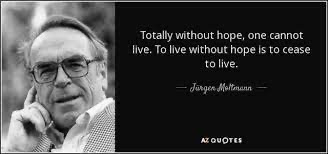
Totally without hope one cannot live. To live without hope is to cease to live. Hell is hopelessness. It is no accident that above the entrance to Dante's hell is the inscription: "Leave behind all hope, you who enter here." That is why faith, wherever it develops into hope, causes not rest but unrest, not patience but impatience. [Theology of Hope, 32]


What is the anecdote to the despair and hopelessness we all feel at times? For Moltmann, it is the resurrection of Jesus Christ, but understood in a new light, not leading to passivity, but to love, compassion and action, including political action.


Believing in the resurrection does not just mean assenting to a dogma and noting an historical fact. It means participating in this creative act of God’s … Resurrection is not a consoling opium, soothing us with the promise of a better world in the hereafter. It is the energy for a rebirth of this life. This hope doesn’t point to another world. It is focused on the redemption of this one.


Faith sees in the resurrection of Christ not the eternity of heaven, but the future of the very earth on which his cross stands. It sees in him the future of the very humanity for which he died. That is why it finds in the cross the hope of the earth. [Hope]


Koskela explains the understanding of resurrection that undergirds Moltmann’s theology:


The resurrection is a powerful word of promise that stands in contradiction to our present experience of suffering and death. Yet this is not a promise that we await passively. On the contrary, we move forward in the light of hope toward the transformation of the world that God will bring. “To believe,” Moltmann writes, “means to cross in hope and anticipation the bounds that have been penetrated by the raising of the crucified.” [Ibid.]


With this understanding in mind, one enters loving action:


That is why faith, wherever it develops into hope, causes not rest but unrest, not patience but impatience. It does not calm the unquiet heart but is itself this unquiet heart in man. Those who hope in Christ can no longer put up with reality as it is, but begin to suffer under it, to contradict it. Peace with God means conflict with the world, for the goad of the promised future stabs inexorably into the flesh of every unfulfilled present. . . Hope is lived when it comes alive, when we go outside of ourselves and, in joy and pain, take part in the lives of others. [Hope]


It would be difficult to exaggerate what a profound effect the Theology of Hope had on my life and vocation. Here was an understanding of God not as a passive judge distant from our suffering, but as one who enters our suffering with us, being present with us in that suffering, crying with us in it. This description of God began to make it possible for me to feel close to God again, as I had in my youth. 


Secondly, here was an understanding of redemption--not as escape from this world with a focus on life after death--but as a deep and powerful engagement with the pain of this life. This theology takes seriously the life and mission of the historical Jesus of Nazareth, who lived a life and founded a movement that welcomed all, based on inclusivity, forgiveness, love, acceptance, solidarity and compassion.


Year later, when I would study the Theology of Liberation, one of its proponents, Rubem Alves, wrote these words about the suffering and hope upon which Moltmann built his theology:


The two, suffering and hope, live from each other.

Suffering without hope produces resentment and despair,

hope without suffering creates illusions, naiveté, and drunkenness . . .

Let us plant dates,

even though those who plant them will never eat them.

We must live by the love of what we will never see.

This is the secret discipline.

It is a refusal to let the creative act be dissolved

in immediate sense experience

and a stubborn commitment to the future of our grandchildren.

Such disciplined love is what has given

prophets, revolutionaries and saints

the courage to die for the future they envisaged.

They make their own bodies the seed of their highest hope.

-- Rubem Alves


As I sit at my desk in my early 70’s, the same theology that gave me “hope” in my early 20’s continues to call me into active love today. As Moltmann put it so well:


As time goes on, we become old, the future contracts, the past expands. . . But by future we don't just mean the years ahead; we always mean as well the plenitude of possibilities which challenge our creativity. . . In confrontation with the future, we can become young if we accept the future's challenges. [Hope]


Friday, November 3, 2023

How My Theology Has Changed, Thank God


Part III: The Journey into Exile


Concordia College, Moorhead, Minnesota

When I left home for Concordia College, in Moorhead, Minnesota--an ELCA Lutheran school--two things happened almost immediately. I was no longer held close and safe in the bosom of my home congregation nor the Bible camping community. Secondly, the world was now wide open for whatever I wanted to study, and I felt the freedom to bring forth fully the struggles I was having with the belief structure in which I had been raised. One of the first issues I took on was the relationship of God to the suffering and grief I had experienced. 


If, indeed, God was all-powerful and all-knowing, then God surely had the ability to keep my parents from dying. I had prayed fervently for them to be healed, but it didn’t happen. Maybe I didn’t pray in the right way. Maybe my faith wasn’t strong enough. Maybe God was judging me for this, and that’s why my prayers were not answered the way I wanted them to be. 


I began to drift away from God. Either I wasn’t a good enough Christian, or God didn’t care enough about me to save my parents from death. Either way, I no longer felt close to God. I didn’t feel I could count on God. I entered college thinking I wanted to be a pastor, but that no longer felt like a path I wanted to pursue. 


I was like the Biblical person, Job. He had been a faithful follower of God, but God had turned on him (or so he thought), taking from him everyone and everything he loved, leaving him in pain and suffering. Like Job, I began to question whether God really was a God of love, a God who would be there for me no matter what happened in my life.  Like Job, I was ready to throw out God rather than throw out my theology. Like Job, the only way I could feel close to God was to begin to question my theology and my assumptions about who God was and how God was related to me and the world. Job does this by challenging God to explain who God really is, and, when God speaks to him out of a whirlwind, Job realizes his theology had it wrong. He had assumed that if he was a faithful follower of God he would not suffer. Now he begins to understand that suffering is a part of life for all of us and God doesn’t guarantee that we will not suffer, but God does promise to be with us in the suffering. 


Well, I hadn’t studied the book of Job when I entered college, and I decided to take another track. I would major in Philosophy to try to understand how the great thinkers of the ages understood God, and I also majored in World Religions, focusing on how the other great religions of the world understood God. Both approaches were extremely helpful, but they also led me to begin to see the relativity of some of my Christian understandings. Of course, to a pious Christian this might seem heretical, but it gave me the courage to begin to question my childhood theology, and whether it was the best way to conceive of God and the world.


Dr. Paul Sponheim

Marcus Borg did the same kind of questioning at Concordia. And he and I were, in part, both saved by the same man, Dr. Paul Sponheim: Marcus as a student at Concordia, and me later when Dr. Sponheim began to teach at Luther Seminary in St. Paul. Marcus writes about his first course from Dr. Sponheim:


The course covered all the big questions: God, the nature of reality, human nature, evil, atonement, ethics, the relationship between Christianity and other religions. It exposed me to the diversity of answers provided by the intellectual giants of the tradition, ancient and modern. . . The experience was fascinating and liberating. Its effect on me was that the sacred cows of inherited religious belief began to fall in a way that legitimated their demise. But it didn’t help me to believe. Rather, it provided a framework within which I could take my perplexity seriously.


As college ended, the images of Christianity and of Jesus that I had received as a child were no longer persuasive or compelling. My childhood understanding of Christianity had collapsed, but nothing had replaced it.  [Again, 8]


My own experience was similar. While the issue that consumed me most was the relationship of God to human suffering, there were other issues as well: the literal interpretation of scripture (regardless of the genre of the writing); the presenting of the faith as primarily a cosmic drama focused on the  issue of human sin, with the primary purpose of Jesus being to die to forgive that sin, thereby neglecting the historical Jesus' teachings about "the way" to be God's faithful people in the world;  emphasizing the afterlife at the expense of this life; the participation of the Christian church--supported by what I saw as “bad theology"--in so much violence both throughout the centuries and in the present world; the racism and sexism present in the theology of the church as well as in the practice of the Christian community. Related to this was the exclusivity and judgmentalism I detected in so many places as compared to the amazing welcome, compassion and inclusion I observed in the life of the historical Jesus. [See Convictions, 9-12]


The two people who shepherded me as I reflected on my faith at Concordia were the two men who guided me in what would become my two majors, Philosophy, with Dr. Tom Christiansen, and World Religions, with Dr. Larry Alderink. Philosophy gave me the tools to think critically and logically about what I did and did not believe, and World Religions not only furnished me with unique and new religious insights but also a basis of comparison as I began to think more critically about what I believed as a Christian.


I will discuss these insights in later posts, but for now I want to turn to the key theological issue that confronted me at that time: the relationship of God to human suffering.


When my parents died, I accepted as truth what I had been taught: that God controls everything that happens in life, and therefore, as painful as it might be, my parents’ deaths were “God’s Will.” This seemed to work for a while, but, as I began in college to look at other ways of seeing God’s relationship to the world, I found myself feeling less and less close to God. I quit going to worship, I seldom prayed, and, although I resisted admitting this at first, I began to feel angry at God. 


This became one of the most difficult and painful times in my spiritual journey. I had loved God so much, and felt so loved by God, but now that began to change. It was clear I could not feel close to the God of supernatural theism (defined at the end of the last post). Does that mean I reject God entirely, or do I search for another understanding of God?


The spiritual journey, with all its twists and turns, does not result--as we say in financial analysis--in a V-shaped recovery, where you head steeply down and then immediately begin an upward ascent. No, first there is the “valley of the shadow of death,” the “forty days and nights in the wilderness,” or, perhaps, most profoundly, a period of Exile, as when the ancient Babylonians conquered Israel and sent her people far away from home to the land of Babylon, where they were separated from all that they loved and held dear. In the words of Borg, 


As a life of being separated from that to which one belongs, exile is often marked by grief, as in one of the psalms of exile: “By the rivers of Babylon, there we sat down and wept when we remembered Zion.”


In our own lives, the experience of exile or estrangement or alienation can be felt as a flatness, a loss of connection with a center of vitality and meaning, when one day becomes very much like another and nothing has much zest. We yearn for something that we perhaps only vaguely remember. Life in exile thus has a profound existential meaning. It is a living away from Zion, the place where God is present. [Again, 126]


Of course, what one longs for in Exile is a Return, a return home. That seldom happens overnight. As I wrote in the first post of this blog series, the spiritual journey is a long and, at times, dangerous quest. Borg states clearly the task that lay before me:


The task of theology is not primarily to construct an intellectually satisfying set of correct beliefs. Its task is more modest. Part of its purpose is negative: to undermine beliefs that get in the way of taking Christianity seriously. Part of its purpose is positive: to construct a persuasive and compelling vision of the Christian life. But being Christian isn’t primarily about having a correct theology by getting our beliefs right. It is about a deepening relationship with God as known especially in Jesus. [Convictions, 50]


In exile I longed for that relationship. I wanted to return. But return to what and to whom? It was time to throw out some of the theology of my upbringing and begin the task of building a new understanding of God and a new vision for myself and the world. 


In my final year of college, with my Philosophy and World Religion courses behind me, I again took a couple of courses in Christian theology. That was the beginning of my return from exile, and while I still felt far from home in many ways, I made the decision to pursue these studies further, and I headed off to seminary at the Lutheran School of Theology in Chicago to do just that.