Thursday, August 2, 2012

Atlanta: Formative Influences in Martin's Early Years

Martin Luther King, Jr. was born January 15, 1929 at home (501 Auburn, Ave., Atlanta, Ga.) to Martin Luther King, Sr. and Alberta Williams King, the 2nd of their three children. Today we toured his birth home, seeing where he studied, learned reluctantly how to play the piano, ate family meals, slept in a single bed with his young brother, A.D., and played baseball and board games like Monopoly.


Down the street two blocks, which we also toured, is Ebenezer Baptist Church, where his father was pastor and he grew up in the Christian faith. It is also the last church he served as a pastor, along with his father, and where his funeral took place. Yes, Atlanta does bring you full circle, but we are getting ahead of ourselves. 


This is the pulpit from which both Martin and his father preached.

The neighborhood Martin grew up in was the Sweet Auburn neighborhood, just east of downtown. It was one of the areas blacks went to after experiencing the segregation of Atlanta, and built their own world. It was filled with all kinds of businesses and many professional folks. Martin could look out his window to the left and see what we call poor row houses. They called them shotgun houses, because if you opened the front door and the back door and shot a shotgun, it would go straight through without touching anything. To the right he would see the affluent houses of successful black entertainers, lawyers, doctors, etc. He grew up middle class, but surrounded by those poorer and richer than himself economically. And he was around many black men like his Father who hated the segregated world of Atlanta, and refused to give in to it. If his Father wasn't served by a white merchant, he would simply leave rather than suffer further humiliation. Martin tells of two childhood experiences that had a profound impact on him: the time his father took him go get shoes and they sat at the front of the store to get fitted. When the proprietor said they had to move to the back of the store, Daddy King, as Martin called him, left the store instead. The other experience had to do with a white boy who was a great playmate from ages 3 to 6, until the white boy's father told Martin he didn't want him hanging around his son anymore.

Of those early years, Martin writes: Of course I was religious. I grew up in the church. My father is a preacher, my grandfather was a preacher, my great-grandfather was a preacher, my only brother is a preacher, my daddy's brother is a preacher. So I didn't have much choice.

When Martin was 15 he went to work on a tobacco farm in Connecticut. He wrote back to his parents. After we passed Washington there was no discrimination at all. The white people here are very nice. We go to any place we want to and sit any where we want to.

The following fall he entered Morehouse College, an historically black school on the west side of downtown Atlanta, 4 1/2 miles form his home. There he encountered more progressive theology which challenged some of the fundamentalist theology on which he had been raised. This was inspiring and enlightening to Martin. It was in his final year there he finally felt the call to ministry: My call to ministry was not a miraculous or supernatural something. On the contrary it was an inner urge calling me to serve humanity.

After touring King's birth home, the church and the wonderful museum dedicated to him across the street from the church, Mary and I decided to drive over to Morehouse. When we came to the campus gate, and asked if we could see the campus, the guard let us in and told us where to go. As we starting trudging up the hill to one of the highest points in Atlanta, where the first Morehouse building was constructed in 1879, a security guard offered to put us in his golf cart and give us a tour. He took us up to that first building, called Graves Hall, which was the dormitory that Martin lived in.  He also got us into the Martin Luther King, Jr. International Chapel, constructed in 1978.


Martin would go from Morehouse to Crozer Seminary in Chester, Pa., and then to Boston University to work on his Ph.D. There he would meet Coretta Scott, whom he would marry one June 18, 1954 Of her he wrote: I am indebted to my wife, Coretta, without whose love, sacrifices, and loyalty neither life nor work would bring fulfillment. She has given me words of consolation when I needed them and a well-ordered home where Christian love is a reality.

Picture from the Museum Above 
Martin received his doctorate in systematic theology in June of 1955. It was time for his first call. Both Coretta's parents and his parents wanted him to remain in the North. But he was determined to return to the South. Against his father's wishes, he took the call as pastor of Dexter Avenue Baptist Church in Montgomery, Al.

Mary and I head in that direction tomorrow.

Much of the material in this and upcoming blogs comes from two wonderful books I have been reading:  Clayborne Carson, The Autobiography of Martin Luther King, Jr.: New York: Grand Central Publishing, 1998 and David J. Garrow, Bearing the Cross:  Martin Luther King, Jr. and the Southern Christian Leadership Conference: New York: HarperCollings, 1986.

Tuesday, July 31, 2012

The A, B, C and D of Violence


Aurora. Birmingham. Columbine. Dallas. Unspeakable and horrifying violence, past and present. Violence that creates such waste, snuffing out so many lives, most of whom are youth and children.


It was 1963. On March 29 Coreta's and Martin's fourth child was born: Bernice Albertine. On April 3 the Birmingham civil rights protests were launched. On April 12 Martin Luther King was arrested and jailed. On April 16 Martin wrote his famous "Letter from a Birmingham Jail" in response to a statement put out by white ministers in Birmingham calling for an end to the demonstrations. On April 20 Martin and his good friend, Ralph Abernathy, were released from jail on bond. On May 11 segregationists bombed the home of Martin's brother, the Reverend A.D. King, and the Gaston Hotel, where King had been staying. On May 13 federal troops arrived in Birmingham.

On June 11 President Kennedy announced a new civil rights proposal. The next day an assassin killed NAACP leader Medgar Evers. On June 22 King met with Kennedy to discuss the violence and the status of civil rights in the U.S. On August 28 King came to Washington, stood in front of the Lincoln Memorial, and delivered the "I Have a Dream" speech to those gathered for the March on Washington for Jobs and Freedom.


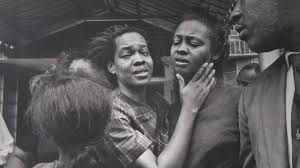
Then on September 15, a dynamite blast at Birmingham's Sixteenth Street Church killed four young black girls while they were in Sunday School. Three days later King attended the funeral and delivered the eulogy for the children. The next day King again met with Kennedy.


On November 22 President Kennedy was assassinated in Dallas. 

Preparing to deliver eulogy for the slain children.

After all of these events, and in response to the death of President Kennedy, Martin Luther King, Jr. wrote the following words. They are words we need to listen to again today:

While the question, 'Who killed President Kennedy?' is important, the question 'What killed him?' is more important.

Our late President was assassinated by a morally inclement climate. It is a climate filled with heavy torrents of false accusation, jostling winds of hatred, and raging storms of violence.

It is a climate where men cannot disagree without being disagreeable, and where they express dissent through violence and murder. It is the same climate that murdered Medgar Evers in Mississippi and six innocent Negro children in Birmingham, Alabama.

So, in a sense we are all participants in that horrible act that tarnished the image of our nation. By our silence, by our willingness to compromise principle . . . . .by our readiness to allow arms to be purchased at will and fired at whim, by allowing our movie and television screens to teach our children that the hero is the one who masters the art of shooting and the technique of killing, by allowing all these developments, we have created an atmosphere in which violence and hatred have become popular pastimes.


Saturday, July 28, 2012

On the Road Again


This Sunday my wife, Mary, and I embark on a three-week journey I have wanted to make for a long time. Geographically we are leaving the Washington D.C. area and heading south to explore the heart of the civil rights movement in this country. We have been reading books about Martin Luther King, Jr. and others in the civil rights movement. With the help of the National Park Service, we have planned our journey.

In a certain sense we began our trip three days ago.  We had traveled to Richmond, Virginia and visited the Museum and White House of the Confederacy.  Our tour guide was a 41-year old black man.  What a strange juxtaposition it was to have an African-American tell us about those who had committed all to keeping his ancestors in slavery.  As for him, so for all of us, understanding our history is a key factor in helping us chart the future God has in store for each of us.  Let the journey begin!

Why the Meandering?


I grew up in a little town in North Dakota, called Maddock.  A few miles south of the town was the Sheyenne River.  It wasn’t much of a river, but it was the only one we had.

When I was quite young my Dad would grab our bamboo fishing poles and we would head to the river, just like Huck Finn and Tom Sawyer, or Andy Griffith and Opie.  The only thing we ever caught were bullheads.  Man, were they ugly.  I didn’t dare take them off the line.  And eating them was out of the question.

Anyway, the Sheyenne, like most rivers, was anything but straight.  In fact, this would come in handy when I was much older.  In the fall we would take our shotguns down to the river to hunt ducks.  We would sneak around the bends and try to surprise the ducks.
Most of the time the ducks were smarter than we were, but once in awhile we would get lucky.

Back to my Dad.  It was from him that I first heard the word “meandering.”  That is how Dad described the Sheyenne.  It just meandered here and there, without any, as we say, “rhyme or reason.”  The Beatles wrote a song about the “long and winding road.”  Well, Dad could have said the “winding” river, but he said the “meandering” river.

According to the dictionary, meandering can mean a “winding course” or an “aimless wandering.”  I like the former better than the latter, at least when it comes to the spirituality of my life.

Like a river, our lives are also not “straight-line.”  There are ups and downs, hills and valleys, right turns and left turns.  Often we feel like we have no idea where we are going.  But, like Gerhard Frost (last blog) we trust that these twists and turns will eventually take us home.  Our task along this journey is to reflect on and find meaning in the wandering, the meandering.  Our tasks is to find meandering spirituality.


Why the Geese?


One of my favorite seminary professors was Gerhard Frost of Luther Seminary in St. Paul, Minnesota., who died in 1988.  The last book he wrote was titled Homing in the Presence, Meditations for Daily Living (Minneapolis: Winston Press, 1978)  This is what Gerhard did: he carried a notebook with him and wrote reflections and poems on things he observed in the world.

On the cover of this book are geese flying, and he writes the following in the Introduction:

One dark evening in mid-November, I was waiting for a bus in Teaneck, New Jersey, when I was startled by what sounded like the honking of wild geese.  It can’t be so, I thought.  I must have brought it with me, this Minnesota sound. . . . . .

The next morning at the same intersection, I heard the sound again.  This time, though, I could see!  I hadn’t been imagining things after all . . . . .All during that day, I felt as if I’d been visited by deep meaning.  These geese, I thought, go back a long way.  Before there was a Boston, or a New York City, or a Baltimore, the wild geese were making their way down the Eastern seaboard.  For centuries, they’ve responded to the call of the seasons and they’ve homed in God’s world.  Their journeys, their repeated homings, are suggestive for me. . . . . .As I think about those geese, I’m filled with a sense of belonging.  I know that God is my home.

This book invites you to reflect on the inward journey.  It is the longest journey of all, the journey home.  It is a journey toward knowing God and being known by him.  It is, itself, a sharing and a homing in the everlasting mercy.

Theologically, we all leave home and go on a journey, a journey which will take us to our final home.  There is tremendous meaning in the concept of home: it is rich, and deep, and so varied for each of us.  But there is also deep meaning in the journey itself. 

Gerhard taught me how to watch the world, and my own life, more closely, and to search along the journey for the manifold ways God is at work in both.