Saturday, October 22, 2016

Muhammad Ali, Part V: Race and Religion: His Legacy


It is always somewhat dangerous to try to summarize a person’s legacy.  Because it is a summary, it leaves out many aspects of a person, including some that are likely inconsistent with the overall portrait.  We also tend to idealize those who have died.

And yet, as we face today’s issues and challenges surrounding race and religion, we do well to consider those who have gone before us who have faced similar challenges, and evaluate how they responded.  Christians ask, “How would Jesus have responded?”  Those who believe in active non-violence ask how Dr. Martin Luther King Jr., or Mahatma Gandhi would have responded.  Those who believe in more active confrontation may ask how Malcolm X would have responded.

Before embarking on this final post, a few words of summary of my journey thus far.  It began by reading several books and articles about Muhammad Ali, and visiting his birthplace, museum and place of burial in Louisville, Kentucky in June.

I realized almost immediately that as a youth I totally misunderstood Muhammad Ali, seeing him as a loud-mouthed braggart who did not represent the way I thought sport should be played.  However, I learned that this was his way of gaining a national, and eventually international, platform from which to speak.  In previous blogs I have talked about the way Islam transformed his life, his political stance against war and violence, and the deep spirituality that undergirded, strengthened, and directed his life.  Now, Muhammad Ali’s legacy.

It is hard to overestimate the extent of his influence, in part because he may have been the most recognizable person in the world.  Famed sports reporter Dick Schaap wrote in 2001: “I’ve covered sports for 50 years and there is no question that Ali is far and away the most significant, the most charismatic, the most charming person that I’ve ever met in sports.  Nobody else is even in second place.  If the Queen of England, the President of the United States, the Pope and Muhammad walked down Fifth Avenue, a lot of people would say, ‘Who are those three people with Muhammad Ali?’  He was definitely the most recognizable human being on earth and he probably still is.” [Muhammad Ali: Through the Eyes of the World, 372.]  African-American sports sociologist Harry Edwards speaks to the kind of person Ali was: “I’ve been around great athletes all my life, and I’ve long since gotten over being awed by them . . . . I wind up dealing with their problems.  I see their human side, and it was from that perspective that I really came to appreciate Ali.  I don’t know of anyone who doesn’t like Ali as a person.  Even when he did things that rankled, he carried himself in such a way that forgiveness was easy because there wasn’t a malevolent bone in his body.” [Hauser, 450.]

Ali loved children.  He would often slip away form adults in order to play with children.  He loved doing magic tricks for them.  However, because Islam teaches that you should never deceive, after the trick he would always show the kids how it was done.

Ali was extremely generous, perhaps too much so.  He made a great deal of money over the years, and many people, including many in his large entourage, took advantage of that generosity.  But Ali had a massive heart, and he was moved by anyone he saw suffering.  Stories like the following abound:  He was at a dinner honoring him at the Aladdin Hotel in Vegas.  He was awarded a large diamond ring.  Leaving the stage, he passed a little girl who was sitting in a wheelchair.  The mother asked Ali if he would pose for a picture with her daughter.  He posed, hugged and kissed her, and then put the diamond ring in her hand for her to keep. [Ibid., 368.]

His generosity included not just giving away gifts.  One time in Los Angeles a Vietnam veteran was having flashbacks and was on the 9th story of a building threatening to jump from his balcony.  Ali walked out to him, put his arms around him, and brought him back.  He then spent $1800 on clothes for the vet and for an apartment in which he could live.” [Ibid. 367-68.]


Ali also cared about other fighters.  Ken Norton was only the second boxer to defeat Ali, breaking his jaw in Ali’s 43rd fight in 1973.  Ali would win their next two bouts.  In 1986 Norton was in a very bad car accident, which left him hospitalized for several months.  Norton writes: “One thing I do remember is, after I was hurt, Ali was one of the first people to visit me . . . . I remember looking up and there was this crazy man standing by my bed.  It was Ali, and he was doing magic tricks for me.  He made a handkerchief disappear; he levitated.  And I said to myself, if he does one more awful trick, I’m gonna get well just so I can kill him.  But Ali was there, and his being there helped me.” [Ibid., 341.]

Another story about Ali speaks to issues involved today in the Black Lives Matter movement.  Pat Patterson was a Chicago policeman assigned to guard Ali in the mid 1970’s.  He writes: “Being with [Ali] affected the kind of policeman I turned out to be.  I was a relatively young man when I met him.  I was about 29, but I hadn’t been on the force long.  And young police, they’re always interested in locking people up.  But with Ali, I realized it was more important to be a peace officer, that people needed help.  He taught me to take time and listen to people.  Watching him, I learned that power shouldn’t be used in a bullying way.  The man was so caring; he cared so much about people. And after a while, you had to know that the way he felt about people was right.” [Ibid., 288-89.]

Actor Dustin Hoffman summarizes Ali well, “They are right when they say fighting was his profession, peace was his passion and grace is his essence.” [Through the Eyes, 190.]

Because of his concern for people, and his recognition throughout the world, at times Ali served as an informal US ambassador.  In 1980 President Jimmy Carter sent him to Kenya regarding the boycott of the Moscow Olympics.  In 1990 he traveled to Iraq to meet with Saddam Hussein.  After 10 days he was successful in having 15 hostages freed.  One of them was Harry Brill-Edwards, who describes his encounter with Ali: “I suppose what impressed me most about Ali was the way he cared for everyone.  He had a kind word or gesture for absolutely everyone he saw.”  Brill-Edwards then had the chance to fly home on a State Department charter, but Ali was not invited on the charter, and Brill-Edwards decided to wait to go on the same flight with Ali, explaining: “I said to myself, I can’t do this. We should be in Muhammad Ali’s presence when we go home.  In the end, six of us stayed on the flight with Ali.  We did it out of sheer gratitude and respect for the man . . . .I told my family when I got home, ‘I’ve always known that Muhammad Ali was a super sportsman; but during those hours that we were together, inside that enormous body, I saw an angel.’”


The world has certainly not overlooked Ali’s legacy.  He has received countless awards, including the Arthur Ashe Courage Award, Sports Illustrated’s Sportsman of the Century, the Presidential Citizens Medal from President Bill Clinton, the Presidential Medal of Freedom from President George W. Bush, and the Otto Hahn Peace Medal in Gold of the UN Association of Germany (DGVN) in Berlin for his work with the U.S. civil rights movement and the United Nations.


On November 19, 2005 the $60 million non-profit Muhammad Ali Center opened in downtown Louisville. It is a wonderful museum displaying not only boxing memorabilia, but it has as a focus Six Core Principles of Confidence, Conviction, Dedication, Giving, Respect, and Spirituality.  Toward that goal, the Center sponsors educational programs on such themes as Gender Equality and Global Citizenship.  On the day I visited, as the Museum was closing for the day, a large group of young folks were being welcomed in to the museum for a special program on global citizenship.  Throughout the Center 19 languages are represented, and the exhibit named the Hope and Dream Wall includes over 5000 inspiring drawings and paintings created by children from 141 countries.


But perhaps for all of us blessed to have children, the most important legacy may be left in the way they see us and describe our lives. Hana Ali, writes: “In the last years of his life, my father, Muhammad Ali, was as beautiful a man with a mission as he had ever been.  He glided across the ring of life as though he were a Messenger of the Spirit.  No obstacle could bring his majesty down.  His step, though slower in pace, was both a testimony and a prayer that he lived in trust and not fear.  No illness could take away his brightness.  It was ever-present in his gleaming eyes and will carry on through the compassion and generosity that flowed like a stream throughout his life.” [ESPN Magazine, 6/27/16, p. 95.]


Monday, September 5, 2016

Muhammad Ali, Part IV: Racism and Religion: Spirituality and Compassion


Muhammad was reviled and castigated throughout America for his stand against being drafted to fight in Vietnam.  He, like Joe Louis before him, was offered the opportunity to avoid jail by entertaining and inspiring the troops with demonstration boxing matches.  Louis accepted that offer.  Ali would not.  He was opposed to the war and would do nothing to support it.  It was a “principled” stand, based on the non-violence he believed essential to his faith.

It is difficult to this day to understand how a man so hated could eventually become one of the most beloved of Americans, both in this country and around the world.  No doubt one of the heights of that adoration was the torch ceremony at the Olympics held in Atlanta in 1996.

No one knew who would be the final receiver of the torch, the one who would light the official Olympic cauldron for those games.  Not even TV host, Bob Costas, knew.  He was simply told by his producers that the person would be instantly recognizable.


Costas was wrong.  Up to the cauldron ran Janet Evans, renowned American swimmer, who had won four gold medals at the previous two Olympics.  When Muhammad appeared to receive the torch from her, she had no idea who he was.  And then, as he appeared, she heard the growing roar, and then the stands began to shake like she had never heard or felt before, and she knew she was in the presence of someone special, someone revered.

The reason for the change in attitude towards Muhammad cannot be found simply in the fact, as mentioned in my last blog, that our nation was becoming increasingly disenchanted with the Vietnam War and the situation of Civil Rights in this country, especially after the assassinations of Martin Luther King, Jr., and Bobby Kennedy in 1968.  I believe the key to that change in attitude is primarily due to who Muhammad was at his core: a very spiritual man who increasingly became a person of love and compassion in general, and one who increasingly moved away from believing in the separation of races.  [For a summary of Ali's remaining fights, see **at the bottom of this blog.]  

When it comes to race and religion, or any moral, political, or theological issue, an important philosophic concept is that of “the orthodox fallacy.”  In short, it is the conviction that whatever I personally believe is the standard by which the world shall be judged.  This fallacy leads to a self-righteous fundamentalism in which we “don’t want to be confused by the facts.”  The problem is that this view is blind to the relativity of cultural, theological, and philosophic commitments.

What can break it?  Many things, but one of the most common ways is travel.  This happened for Muhammad.  Shortly after winning the heavyweight title the first time, Muhammad went on a trip to Ghana, Nigeria, and Egypt, which would be the start of a lifetime of worldwide travel.  Two important things happened on that trip.

Osman Karriem explains the first: “that trip to Africa . . . . is where I saw Cassius Clay become Muhammad Ali.”  He tells of driving down a rural road in Ghana and out of seemingly nowhere there appeared lining the road people beating drums and yelling out “Ali!  Ali!”  “Do you have any idea what it must have been like for him to see thousands of people materialize out of nowhere and know they were there just for him?”  [in Hauser, Muhammad Ali,112]


This adoration would continue throughout his life.  Biographer Thomas Hauser writes: “Muhammad Ali is the most loved person in the world.  Everywhere he goes, wherever he goes, people of all colors and religions crowd around, hoping to get close to him.  I’ve seen it happen so many times. And each time, I ask myself, ‘If we can all get together and have a meeting of the minds on Ali, why can’t we all get together, period?’”  I look at this man and I say to myself, ‘God is trying to tell us something.’” [Hauser and Ali, Healing: A Journal of Tolerance and Understanding, back cover]

Travel is what led Ali to realize that God might be calling him to a unique role to break down religious and racial barriers and thereby bring people together.  His spiritual journey led him to reject the separatist ideology of Elijah Muhammad and embrace this new way of seeing the world.  In his words, “Hating people because of their color is wrong.  And it doesn't matter which color does the hating.  It's just plain wrong.”

And Muhammad never quit trying to learn.  He said, I set out on a journey of love, seeking truth, peace and understanding.  I am still learning.”

Another part of this growing spirituality is the way in which Ali’s faith and trust in God continued to deepen over the years, not only now leading him to see the commonality of all humans, each being loved by God, but providing the strength and courage to persevere through his many trials.


As he was facing prison for refusing to be drafted, several other prominent athletes gathered to advise him, including Jim Brown, Kareem Abdul-Jabbar, and Boston Celtic great, Bill Russell.  After their meeting, Russell stated: “I envy Muhammad Ali. . . . .He has something I have never been able to obtain and something very few people I know possess.  He has an absolute and sincere faith.  I’m not worried about Muhammad Ali.  He is better equipped than anyone I know to withstand the trials in store for him.  What I’m worried about is the rest of us.” [in Hauser, Muhammad Ali, 179.]

This deep faith led him to feel compassion for all people.  In spite of the violence of the sixties in America, and the assassinations of so many leaders; in spite of the growing terrorism throughout the world in the seventies and eighties, Ali scorned security precautions and insisted on moving freely.  His training camps were open camps. Anyone could stop by and chat, or have a meal.  His homes, much to the consternation of his families, had an open door policy.  Anyone could stop by to say hi or obtain an autograph.  And he insisted on mingling among the crowds wherever he was in the world.  He once stated, “I don’t need no bodyguards or guns.  God is my bodyguard; Allah watches over me.  If I walk into a stadium with a hundred thousand people, no human can keep somebody from putting a bullet in me.  But I can’t be worrying about things like that.  A man filled with fear don’t live and enjoy life.  So I trust in God to look after me.” [Ibid., 287].

Muhammad Ali began each day at 5 am, rising from bed, washing himself with clear running washing, as mandated by the Qur'an, putting on clean clothes, facing Mecca to pray, and then reading the scriptures.  [See ibid. 13]  Each day, every day. 

Thomas Hauser tells of a trip to Indonesia, where at the Grand Mosque in Jakarta, a crowd estimated at 200,000 people waited to greet Muhammad.  They surrounded the car, yelling "Ali!  Ali!"  Ali beseeched the driver, "Go slow; please, don't hurt anyone."  

After 10 days there, they began the flight back home through twelve time zones.  Hauser drifted off to sleep and awoke several hours later. Outside the plane it was pitch black.  The cabin was dark: everyone was asleep, except Muhammad.  His overhead light was on and he was reading the Qur'an.  Hauser writes: "And in that moment, bathed in light, he looked stronger and more at peace with himself than any person I've ever known." [Ibid., 516]

As the years went by Muhammad became more and more interested in Sufism, a dimension of Islam that seeks inner, mystical peace.  And he found that peace.  His daughter, Hana Ali, wrote shortly after Ali’s death:


“If you could have borrowed my eyes and seen my father in the calm of his later life, you would not have mourned what he lost.  When we observe the source of true strength, we find that the power of a hand is best measured not by its weight but by the amount it can lift.  Muhammad Ali’s vitality came from a place deep within.  It came from his courage to fall and his will to rise.  It came from his awareness that every moment under the sun has a purpose and a time.  If you could borrow his heart, you would not question what he sacrificed but rather pray for the peace of his gentle soul.” [ESPN Magazine, 6/27/19, p. 95]

**Summary of Ali's remaining fights.
As stated in the last blog, Muhammad was not allowed to fight in the US or anywhere in the world for nearly 3 ½ years, from March 1967 to October 1970 (from ages 25 to almost 29).  The journey to reclaim the heavyweight title for the third time would be long and difficult.  His first attempt, in the “Fight of the Century” against Joe Frazier at Madison Square Garden, would end in a loss by Unanimous Decision after 15 brutal rounds. (3/8/71).  He would beat Frazier in their rematch 14 fights later (1/28/74), but by then Frazier had lost the crown to George Foreman.  His next fight was against Foreman, in the “Rumble in the Jungle,” (10/30/74) in Zaire, which would finally give Ali his title back with a Knockout in Round 8, having used his new “rope-a-dope” strategy to weather Foreman’s punishing blows.

He would defend that title in his third fight against Frazier, the “Thrilla in Manilla” with a TKO in Round 14 (10/01/75).  It was a brutal fight fought in near 100 degree temperatures.  Afterwards an ailing Ali said: “It was the closest thing to dying that I know” and he declared Frazier “the greatest fighter of all times next to me.”  When asked later if he had ever watched the video of the fight, he exclaimed: “Why would I want to go back and see Hell?”

He would continue to retain that title for six more fights, until he finally lost it to Leon Spinks on 2/15/78.  Yet once again he reclaimed the title in their rematch seven months later.

Most everyone thinks Ali should have retired at that point, if not much sooner.  However, two years later he lost his title to Larry Holmes in a match in which he was pummeled relentlessly (10/02/80).  That was followed by another needless beating a year later at the hands of Trevor Berbick (12/11/81), all of which has led to considerable speculation about the effect these final bouts had on Ali’s long-term health, including the onset of Parkinson’s Disease in 1984.

In the next, and final blog entry, we will discuss Muhammad Ali's legacy.


Thursday, August 11, 2016

Muhammad Ali, Part III; Race and Religion: The Vietnam War


After Muhammad Ali died, the best reflection on his life that I read was written by Kevin B. Blackistone, who teaches at the University of Maryland, is an ESPN panelist and writes sports commentary for the Washington Post.  In the June 7, 2016 edition he writes:

     “It is common for archaeologists to find in the graveyards of African American slaves in the Americas objects from their tortured lives.  For the burial place became one of the few places where enslaved Africans could lay bare who they were and from whence they came.
      The immediate wake of the death of Muhammad Ali reminds that he—progeny of Dinah, his great-great grandmother who was a slave—must be, like his ancestors, so memorialized.
       With the secret FBI memo of Feb. 13, 1964, to FBI boss J. Edgar Hoover, categorized as a ‘security matter,’ on the findings of a meeting between FBI agents and Ali’s manager, Angelo Dundee, about Ali’s connection to the Nation of Islam.
       With the announcement from the World Boxing Association on September 14, 1964, that it was defrocking him of the world heavyweight championship he’d won earlier that year against Sonny Liston because of his conversion to Islam, rejection of his given name Cassius Clay as, he said, a ‘slave name’ and openly taking counsel from the militant Malcolm X.
      With the announcement from the New York State Athletic Commission and World Boxing Council on April 29, 1967, that both were stripping him of his restored world heavyweight champion’s belts for mustering the boldness that day to refuse conscription in the U.S. Army and saunter from the Houston Induction Center despite threat of a five-year prison sentence.”  [Washington Post, 6/7/16, p. D3.]

Between his being stripped of his title in 1964, and his suspension from boxing in 1967, Ali would fight 9 more times, winning all of the bouts and in the process claiming all the heavyweight titles recognized at that time.  However, because of the disfavor into which Muhammad had fallen with so many in America, four of those fights were overseas, in Canada, England and Germany, where a larger crowed could be drawn.

As explained in my last post, before Ali was defrocked the first time, he had had three years to be involved with the Islamic faith during which he had solidified his beliefs.  He was thus very articulate from the beginning about the ways in which he found meaning in Islam as compared to his Christian upbringing.  However, the events leading to his suspension started very differently, beginning  with an off-the-cuff statement Ali made in frustration with being hounded by the press.  First, the background.

Like all of us in that generation, Cassius registered with the Selective Service (military draft) at the age of 18 (1960).  In January of 1964, a month before the first Liston fight, Cassius was ordered to take the military qualifying exam.  He easily passed the physical portion of the test, but, being dyslexic and a poor reader, he failed the mental aptitude test.  He retook the test three months later, and failed again.

When the press got ahold of this, there was an uproar that Ali was not being drafted because of his fame.  For Ali, this whole process was embarrassing.  But you have to love his response to reporters, “I said I was the greatest, not the smartest.”

By early 1966, with the war in Vietnam growing, the military lowered the aptitude percentile that was passing from the 30th to the 15th percentile (Cassius was at  the 16th), making him now eligible to be drafted.  Within hours Ali’s phone was ringing off the hook from the news organizations.  About the 10th time he was asked about the war, Ali exploded, “Man, I ain’t got no quarrel with them Vietcong.”

The next day most of the sports writers across the country raged against him as an unpatriotic draft-dodger.  One of the most famous sports writers of all time, Red Smith, penned: “Squealing over the possibility that the military may call him up, Cassius makes himself as sorry a spectacle as those unwashed punks who picket and demonstrate against the war.”

Thus began a series of legal hearings as Ali requested an exemption from the draft on the basis of conscientious objector status, a category the government reserves for those who, on the basis of their religious faith, are opposed to involvement in wars of any kind.  In Ali’s words, “How can I kill somebody when I pray five times a day for peace.” [Hauser, 155]

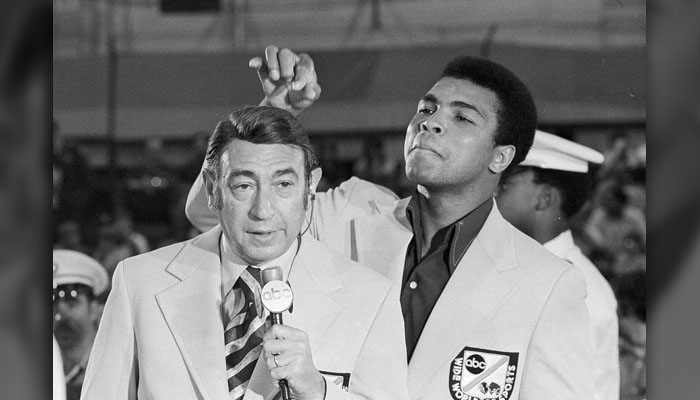
His initial request was denied, and he was sentenced to five years in jail.  However, a series of appeals kept him free until the Supreme Court overturned the denial some four years later, on the grounds that his conscientious objector status had not been properly recognized.  However, with the New York commission stripping him of his title for the second time, all the other states following suit,  and the US government confiscating his passport, Muhammad Ali, at the height of his career, was drummed out of boxing for 3 1/2 years.  Famed reporter, Howard Cosell, fumed:  “Due process of the law hadn’t even begun, yet they took away his livelihood because he failed the test of political and social  conformity, and it took him seven years to get his title back.  It’s disgusting.  To this day I get furious when I think about it.” [Ibid., 173]

{Howard Cosell and Muhammad Ali, August 17, 1972)
In theological ethics, we distinguish between principles and context.  Conscientious objection is a principle, as one states that s/he believes all killing is immoral.  The Just War Theory, recognized by many religious bodies (but not by the US government), argues that killing can be either moral or immoral, depending on the context.  Ali seems to have believed both. He saw the war as another example of neocolonial racism, and he also, based on his religious convictions, felt killing was immoral.  On April 28, 1967, he wrote, “‘Why should they ask me to put on a uniform and go ten thousand miles from home and drop bombs and bullets on brown people in Vietnam while so-called Negro people in Louisville are treated like dogs? . . . .I either have to obey the laws of the land or the laws of Allah.   I have nothing to lose by standing up and following my beliefs.  So I’ll go to jail.  We’ve been in jail for four hundred years.” [Ibid., 167]

Ali was ahead of his time in raising the issue of the morality of the Vietnam War.  Eventually Martin Luther King, Jr., would do the same, and the anti-war protest would continue to grow until it became a major campaign issue in the election of 1972.  During his exile from boxing, (and in part to make a living), Ali would help that movement grow by going around to college campuses to explain why he was willing to risk jail rather than go into combat.

I think it could be safely argued that anyone who dares to challenge the extent to which the United States lives up to what has been called the “immortal declaration” that Thomas Jefferson wrote into the U.S. Declaration of Independence, that “all men are created equal,” will suffer greatly.  Just take a look at the vitriol stirred up these days as we struggle with what race and religion mean when it comes to equality within our nation.

Charles P. Pierce shares his view of how Muhammad Ali fits into this ongoing struggle:

      “In 1849, Herman Melville made the point that ‘the Declaration of Independence makes a difference.’  He meant that it changed how people should think about themselves, and how they should express themselves.  He was talking about the contradiction in the nation’s birth, and he meant that the measure of an American must be how willing he is in his public life to call Jefferson’s great bluff.  I am created equal?  I have certain unalienable rights?  O.K., watch me exercise them to their fullest.  Or is your country a lie?  Raise or call?
      That was the implicit message of Muhammad Ali’s life.  He was a great American athlete.  He was an essential American.  He was a powerful pivot in American history.  He was such a better American citizen than the people who denigrated him for his brashness, who spat on his religion, who called him a coward because he wouldn’t be an accessory to mindless slaughter and who hounded him out of his profession at the height of his powers and influence.  They were the American government.  He was America, the great and self-evident contradiction of a nation, and that, as Melville warned us, makes all the difference.” [Sports Illustrated, 6/13/2016, p. 45.]


Saturday, July 23, 2016

Muhammad Ali, Part II; Racism and Religion: Conversion to Islam


[May 17, 1962, Age 20]

To understand Muhammad Ali, one must dig into how he understood the issues of race and religion, which were intertwined for him.  However, no one cared much about his views until he shocked the boxing world by winning the heavyweight title on February 25, 1964.

Almost all boxing experts rank Muhammad Ali as the greatest boxer of all time.  However, in his first fight with Sonny Liston for the heavyweight title, he was no better than a 7-to-1 underdog.  Comedienne Jackie Gleason, a fight fanatic, wrote in the New York Post:  “I predict Sonny Liston will win in 18 seconds of the first round, and my estimate includes the three seconds Blabber Mouth will bring into the ring with him.”


Ali’s style was extremely unorthodox.  He kept his hands down and did the “Ali Shuffle,” moving in a clockwise circle around Liston, daring him to punch him.  He knew exactly what Liston’s reach was, and whenever Sonny would punch, he would move his head back just far enough not to be hit.  He purposely had the word spread to Liston’s camp that he was scared to death of Liston, in the hope that this would lead Liston to slack off on his training.  His goal was to wear Sonny down, who had trained to go only 3 rounds, and had predicted a knockout in Round 2.  When Round 7 was to begin, Sonny remained in his chair, unable or unwilling to go any further, and Ali, in his 20th professional fight, was now the heavyweight champion of the world by TKO (Technical Knockout).  Now the boxing world was forced to take Muhammad Ali seriously, and they wasted little time in getting down to business.

The day after winning the title, Muhammad was confronted at his press conference.  The question was direct, “Are you a card- carrying member of the Black Muslims?”

When I visited the Clay family home in Louisville, there was a picture of Odessa Clay, Cassius’ and Rudy’s Mother, dressing them up in their Sunday best to go off to her Baptist church.  This is how Muhammad’s spiritual journey began, but not how it would end.  

Elijah Muhammad, leader of the Nation of Islam, had his headquarters in Chicago.  In 1959 at a Golden Gloves Tournament in Chicago, Ali came across a copy of the Nation’s newspaper, Muhammad Speaks.  He explains the effect on his views:  “I didn’t pay much attention to it, but lots of things were working on my mind.  When I was growing up, a colored boy named Emmett Till was murdered in Mississippi for whistling at a white woman.  Emmett Till was the same age as me, and even though they caught the men who did it, nothing happened to them.  . . . . In my own life there were places I couldn’t go, places I couldn’t eat.  I got a gold medal representing the United States at the Olympic Games, and when I came home to Louisville  . . . .there were restaurants I couldn’t get served in.  Some people kept calling me ‘boy.’  Then in Miami [in 1961] I . . . .met a follower of Elijah Muhammad named Captain Sam.  He invited me to a meeting, and after that, my life changed. . . . .For three years, up until I fought Sonny Liston, I’d sneak into Nation of Islam meetings through the back door. . . . .I was afraid, if they knew, I wouldn’t be allowed to fight for the title.” [Thomas Hauser, Muhammad Ali, p. 89, 97]


It was while Muhammad was training in Miami that he starting spending time with Malcolm X, who treated him like a younger brother.  Rumors floated around before the fight that Cassius had converted from Christianity to Islam, but the promoters of the fight did not want that word to get out, for fear it would hurt interest in the fight.  Cassius went along with this request, and avoided saying anything about his religious allegiances before the fight.  But, now that the fight was over, and he was the champion, he confronted the issue head on, stating:

“‘Card-carrying.’  What does that mean?  I believe in Allah and in peace.  I don’t try to move into white neighborhoods.  I don’t want to marry a white woman.  I was baptized when I was twelve, but I didn’t know what I was doing.  I’m not a Christian anymore.  I know where I’m going and I know the truth, and I don’t have to  be what you want me to be.  I’m free to be what I am.”

The next day Clay explained his views further.  He rejected the term “Black Muslim” as a “press word,” explaining, “It’s not a legitimate name.  The real name is ‘Islam.’  That means peace. . . .I ain’t no Christian.  I can’t be, when I see all the colored people fighting for forced integration getting blowed up."  [Remnick, pp. 205-208].

Ten days later Elijah Muhammad in a radio broadcast announced, “This Clay name has no meaning.  I hope he will accept being called by a better name.  Muhammad Ali is what I will give him for as long as he believes in Allah.”

In the words of Ali himself, “Changing my name was one of the most important things that happened to me in my life.  It freed me from the identity given to my family by slave masters.”  [Hauser, 102]  “‘Cassius Clay is a slave name. I didn’t choose it and I don’t want it.  I am Muhammad Ali, a free name – it means beloved of God, and I insist people use it when people speak to me and of me.”

For Ali, then, his religious faith tied directly into his understanding of race.  He chose to stand on the side of “”black pride” and “black is beautiful.”   In his words, “I am America.  I am the part you won’t recognize.  But get used to me.  Black, confident, cocky; my name, not yours; my religion, not yours; my goals, my own; get used to me.”

[With Rahaman Ali, June 2016
When I visited Muhammad’s childhood home, and met his brother, Rudy, I asked him when he became Rahaman Ali, and he said at the same time that Cassius became Muhammad Ali.  We then discussed the reasons behind this change in faith, and it is impossible not to see the irony in reference to the conflict between Christianity and Islam today, along with the struggle of blacks today to achieve equality within our society.

Cassius and Rudy experienced Christianity as the religion that stood behind slavery in the past, and now supported segregation.  And it was Christians who resorted to violence in the attempt to destroy the civil rights movement.  The Nation of Islam thought Martin Luther King, Jr. and the other civil rights leaders were naive to believe that white people would ever really accept blacks as equals.

For Cassius and Rudy, Islam accepted everyone and was the religion of peace.  It was also opposed to alcohol and adultery.  Now, one can find examples where these ideals were not upheld, but it is significant to note that it was those ideals that Cassius found to be much more attractive than his experience of Christianity, and were the reasons behind his conversion, a conversion that would cost him dearly.  Within months of winning the title, the World Boxing Association stripped him of his title because of his name change and conversion to Islam.

But what will cost him even more is the stand that he would take on the Vietnam War and his refusal to be drafted, which will be discussed in the next blog.

In the three Judeo-Christian religions that dominate the Western world, over and over again we see that each of these historic faiths has been used to justify violence, subjugation, and oppression, and each also can be the bedrock on which forgiveness, understanding, peace and reconciliation can be built.  Nelson Mandela experienced oppression at the hands of mostly Christian whites, but then, when released from prison, found in Christianity the forgiveness and love that would lead to reconciliation and truth in South Africa.


In the case of Muhammad and Rahman Ali, they found acceptance and peace by turning to Islam.  As Muhammad once said, “I learned something from people everywhere.  There’s truth in Hinduism, Christianity, Islam, all religions.  And in just plain talking.  The only religion that matters is the real religion — love.  I’m color blind.  I love people. Black, white, rich or poor.”