Tuesday, September 22, 2020

Have You Lost Your Spiritual Center?


If you are human, you have a spiritual center. If you are human, you most likely lost it somewhere along the way.


There may have been times when your life has been going along well enough that you didn’t notice that you had lost it. But as soon as struggle appears, with all its intense and often negative emotions, you most likely realized that you were lacking something, but you probably didn’t know what it was, let alone how to find it.


You may even have tried to find it. You might have gone to a therapist. You might have gone to worship. You might have picked up and started to read the scripture of your tradition. That might have helped some, but somehow you knew it was not getting you to where you wanted and needed to be.


You had a spiritual center in the womb. You basked in the warmth and love that surrounded you. You also were in touch with your spiritual center after you were born. You knew you were surrounded with love and people who really wanted to meet your every need.


But then something happened. Something that made you wonder if you really could trust the people around you and the world that enfolded you. And once that happened, things began to unravel quickly. As the days and months and years passed by, you had all kinds of feelings that fought against your spiritual center. You felt anger. You became suspicious. You were no longer sure the world was a safe place for you.


You felt remorse for things you had done and said. You were angry at others, and knew you should forgive them, but just couldn’t. You felt shame, that strange and permeating emotion that leads us to feel we just don’t quite measure up, we are not quite good enough.


When you were in the womb, you lived in the present. You weren’t obsessed with the past or what might happen in the future. You basked in life as it came to you. You trusted life as it came to you.



Now, you seldom live in the present. You fret over the past, and can’t quite get beyond the wrongs that were done to you. You still feel hurt by what your father said or didn’t say to you. Psychologists say that over half of grown men are still trying to please their fathers, long after they are gone. You remember the fights you had with your mother. You remember the unkind things you said to her, and the ways she may have hurt you.



The future is even worse. You don’t live in the present because you have so many things to worry about. Will we have enough money? Who will win the next election? Will my health hold up? Will I get Covid19, or will someone I love get it? Will I ever have grandchildren? Will there be enough rain for the crops this year? Will I ever find a good job? With all the cutbacks going on, will I lose my job? It is not that these things are not important. Some are life or death. But, as Jesus, said: “Can any of you by worrying add a single hour to your span of life?” [Matthew 6:27]


Even when you are Facetiming your family or your friends, you think of the ways you failed them, you feel anxiety about their futures. You have trouble really listening to them right now, and hearing what they are saying, and feeling their love.


When we lose our spiritual center, we have difficulty living in the present, and thereby we lose our grounding, our secure center, our ability to give and receive forgiveness, our ability to give and receive love.


When we lose our spiritual center, we forget what we each know deep down in our hearts: that love is, in the end, the only thing that matters. Love is what we want, what we need, and--as hard as it is to believe--love is surrounding us and available each moment of life, making it possible to live joyously in the present. St. Paul said, “Now faith, hope and love abide, these three; and the greatest of these is love.” And every religious tradition I know of says the same, in one way or another.



 Spiritual writer, Mirabai Starr, explains:


The sacred scriptures of all faiths call us to love as we have never loved before. This requires effort, vigilance, and radical humility. Violence is easier than nonviolence, yet hate only perpetuates hate. The wisdom teachings remind us that love—active, engaged, fearless love—is the only way to save ourselves and each other from the firestorm of war that rages around us. There is a renewed urgency to this task now. We are asked not only to tolerate the other, but also to actively engage the love that transmutes the lead of ignorance and hatred into the gold of authentic connection. This is the “narrow gate” Christ speaks of in the Gospels [Matthew 7:13]. Don’t come this way unless you’re willing to stretch, bend, and transform for the sake of love.


Your spiritual center is God in you, connecting you through love with all the world. That center is filled with everything we need to live joyously in the present: forgiveness, trust, hope, reconciliation, love. There we can let the past go, and there we do not have to worry about the future. There we can find peace of mind and peace of spirit, every day of our lives.


Etty Hillesum, 1914-1943 

What and where is your spiritual center? No one put it better than Etty Hillesum, killed at Auschwitz in 1943:


There is a really deep well inside me. And in it dwells God. Sometimes I am there, too … And that is all we can manage these days and also all that really matters: that we safeguard that little piece of You, God, in ourselves.

Saturday, September 12, 2020

Civil Disobedience, Law and Order, and Active Nonviolent Protest


Throughout our nation we see example after example of Civil Disobedience through Active Nonviolent Protest running head on against cries for and actions promoting Law and Order. One might assume these are two polar opposites, and one must choose one over the other. However, Civil Disobedience, properly understood, is actually in harmony with Law and Order. Thomas Merton puts it succinctly: “The theory of civil disobedience permits only disobedience of a law that has been shown to be unjust and at the same time it affirms respect for law and order as such by accepting punishment for the act of disobedience. This aspect of civil disobedience is often overlooked. “[The Nonviolent Alternative, 227-28]
      
For example, in the Nashville Sit-ins described in my last post, the blacks taking a seat at “white only” lunch counters, when arrested, insisted on being taken to jail. As that happened, more blacks took the seats they had vacated, and were in turn hauled off to jail. In fact, the protests had almost been called off because there was not enough money to pay bail for so many protesters going to jail. However, the students had adopted a “Jail-No-Bail” philosophy, meaning they preferred to be punished by the law rather than be bailed out. Eventually there were so many students in jail that the police decided to simply let them go.


This position of “Jail-No-Bail” had been adopted by Martin Luther King’s organization, the Southern Christian Leadership Conference, as a way of showing that the protests were not against the law as such, but only against laws they believed to be “unjust.”  There are many examples where King himself, John Lewis and other Civil Rights leaders refused bail as a way to draw greater attention to the injustices the movement was trying to bring to the light of day.

The concept of Civil Disobedience was first coined by Henry David Thoreau in his 1848 essay where he described his decision not to pay a state poll tax that had been enacted to prosecute a war in Mexico and support the Fugitives Slave Law that required slaves in free states to be returned to their owners in slave states. This was his way to protest what he felt were unjust laws and causes, and he spent time in jail as a result.

Philosopher John Rawls, in 1971, developed the concept of Civil Disobedience further. “Civil disobedience is a public, non-violent and conscientious breach of law undertaken with the aim of bringing about a change in laws or government policies. On this account, people who engage in civil disobedience are willing to accept the legal consequences of their actions, as this shows their fidelity to the rule of law. Civil disobedience, given its place at the boundary of fidelity to law, is said to fall between legal protest, on the one hand, and conscientious refusal, . . . . on the other hand.” [Stanford University Encyclopedia of Philosophy.]

The first task of Civil Disobedience, then, is to determine which laws are just and unjust. Martin Luther King, Jr. explained this in his famous “Letter from a Birmingham Jail,” where he had landed because the city would not issue his group a permit to demonstrate, and he went ahead and began a march anyway.  The result was spending a week in jail.  King writes: “One may well ask: ‘How can you advocate breaking some laws and obeying others?’ The answer lies in the fact that there are two types of laws: just and unjust. I would be the first to advocate obeying just laws. Conversely, one has a moral responsibility to disobey unjust laws. I would agree with St. Augustine that ‘an unjust law is no law at all.’” [LBJ, 93]

For example, I have been bringing groups to the border between El Paso and Juarez for nearly 20 years to focus on border violence and immigration laws. One time a Border Patrol agent explained that when his father worked for the Border Patrol, there were no barriers between the US in Mexico, except for the Rio Grande River, which can be easily crossed in most places. People freely went across to work in the US, and then returned at night to their homes in Mexico. Though technically illegal, many times, especially when the harvest of a certain crop was near, the agents were actually told to just “look the other way.”

Then began a long process of making the laws stricter. First, it was a misdemeanor to try to cross without papers. Then it was made a felony. Then, if you were caught trying to cross, you had to go back, wait a certain length of time, often years, and reapply for entry. And, by the way, these days it is nearly impossible to get re-entry papers.

Let me give you example of how this might play out. I met a family of a mother, father and daughter who crossed some 20 years ago when it was just a misdemeanor. They settled down, got work, paid taxes and eventually had two more children, who are US citizens. The daughter brought across as an infant applied for the DACA program, and was accepted.

A few years ago, the father went back to Mexico for his mother’s funeral. He had work papers, but there was something not signed properly, and, when he came to the border, he was sent back to Mexico. Now, if you were him, what would you do? He tried to cross, and again was caught. This time he was told he had to go back to Mexico for five years, and then reapply for entry. And the daughter in the DACA program has not known for the last few years what her future will be.


Those of us working for immigration reform are not saying there should be no laws, or no borders. But we are challenging the fairness of laws that have kept changing over the years, and now are tearing hard-working, peaceful families apart, and leaving DACA students, many of whom have completed college or served in the military, unable to know if they will be allowed to stay in the country in which they grew up.


Two days after "Blood Sunday" Protesters tried Again, Confronted Resistance, Knelt and Prayed, and Turned Back. Only on the third try, with Protection from Federal Troops, did they make it to Montgomery.
For the spiritual person, the basis on which one analyzes such laws comes from one’s understanding of what God wants for the world. Thomas Merton explains it this way: “The Christian is and must be by his very adoption as a son of God, in Christ, a peacemaker (Mt. 5:9).  The Christian is one whose life has sprung from a particular spiritual seed: the blood of the martyrs who, without offering forcible resistance, laid down their lives rather than submit to the unjust laws. . .  That is to say, the Christian is bound, like the martyrs, to obey God rather than the state whenever the state tries to usurp powers that do not and cannot belong to it.”  [The Nonviolent Alternative, 13]

When I was growing up, my parents used to regularly say to me, “Now, Brian, don’t get into trouble.” John Lewis’ parents told him the same thing. The difference was that the trouble he was contemplating was far more serious and important than any trouble I might get into. He was trying to overcome segregation laws that he believed were immoral, and opposed to the ways of God. 

John Lewis, on Black Lives Matter Plaza in Washington DC, just days before he died.

In his words: “As a young man I tasted the bitter fruits of segregation and racial discrimination, and I didn’t like it. I used to ask my parents, my grandparents, and my great grandparents, ‘Why segregation? Why racial discrimination?’ And they would say, ‘That’s the way it is. Don’t get in trouble…’ But when I heard the words of Dr. King, I knew then that I could strike a blow against segregation and racial discrimination, and I decided to get in trouble. I decided to get in the way. But it was good trouble, necessary trouble. Democracy is not a state. It is an act.”  

His final words of comfort and direction were printed in the New York Times on July 30, 2020: “Though I may not be here with you, I urge you to answer the highest calling of your heart and stand up for what you truly believe. In my life I have done all I can to demonstrate that the way of peace, the way of love and nonviolence is the more excellent way. Now it is your turn to let freedom ring."

Friday, August 14, 2020

Active Nonviolence is Dangerous


When John Lewis went into battle on Bloody Sunday, March 7, 1965, at the Edmund Pettus Bridge in Selma, Alabama, he was armed with an army surplus backpack carrying the weapons of a toothbrush, an orange and an apple, and two books, one of them by Trappist monk Thomas Merton, who writes about the spirituality of nonviolent protest.

Lewis was only 25 years old, but he was already experienced in this kind of spiritual confrontation. When he was 20 at the Nashville Sit-Ins, he and his fellow counter sitters had mustard, ketchup and coffee poured 

on their heads, cigarettes put out in their hair, and they had been dragged from stools and kicked and punched as they tried to get some food and drink at segregated lunch counters in downtown Nashville. 


John Lewis and James Zwerg after Beating


When Lewis was 23, as part of the Freedom Riders form Washington DC to New Orleans, he was beaten twice, once in South Carolina and then again, into unconsciousness, along with James Zwerg, at the Greyhound bus depot in Montgomery, Alabama. In addition, one of the buses was fire bombed in Anniston, Alabama by 200 angry whites, but, fortunately, no one was seriously injured. As Lewis told us the last time I heard him speak, he had been arrested over 40 times and jailed many times. Active nonviolence is certainly not an endeavor for the faint of heart. 


In the next three posts I will reflect on why nonviolence can be so dangerous, the dynamics of civil disobedience, and the spirituality of nonviolence, which is at the heart of the Christian gospel, although the civil rights leaders of the 50’s and 60’s had to go to India and explore the work of Hindu Mahatma Gandhi in order to learn how to appropriate it’s truth and method.

Thomas Merton and the Dalai Lama living in exile in India, who won the Nobel Peace Prize  in 1989 for nonviolent protest as a path to social change.

First, we have to distinguish between passive and active nonviolence. Passive nonviolence, which means sitting back and doing nothing, does not create social change. In fact, it makes things worse by unintentionally continuing to support the status quo. On the other hand, as Merton explains:

The genuine concept of nonviolence implies not only active and effective resistance to evil but in fact a more effective resistance. But the resistance which is taught in the Gospel is aimed not at the evildoer, but at evil in its source. It combats evil as such by doing good to the evildoer, and thus overcoming evil with good (Romans 12;21), which is the way our Lord Himself resisted evil. [The Nonviolent Alternative, 177]

How then, did this approach to social change make its way into the Civil Rights Movement?

James Lawson and Martin Luther King, Jr.

If you watched John Lewis’ funeral service, you saw a 91-year-old Methodist pastor, James Lawson, speak. He grew up in Ohio, and went as a missionary to India where he studied Ahimsa (nonviolent resistance) and Satyagrapha (steadfastness to truth), the form of nonviolent resistance developed by Gandhi. Returning to Ohio in 1955, he enrolled in the Graduate School of Theology at Oberlin College, where one of his professors introduced him to Martin Luther King, Jr., in 1957, who urged him to move "to the South" by joining the faculty at Vanderbilt University in Nashville. There he began teaching nonviolent protest techniques in the basement of First Colored Baptist Church, along with its pastor Kelly Miller Smith, to students who included John Lewis, Diane Nash, James Bevel and Bernard Lafayette, who became the leaders of the Nashville Sit-Ins.

Diane Nash and Kelly Miller Smith
As for King, he encountered the concept of active nonviolence when, after graduating from Moorhouse College in Atlanta at the age of 19 (he was a brilliant student), he entered Crozer Theological Seminary in Chester, Pa., and learned of Gandhi's use of active nonviolence to drive the British out of India. Then, in 1958, Martin and Coretta both went to India to learn more about the work of Gandhi for themselves. 

Merton explains further the relationship of this method of social change to spirituality:

What is certainly true is that Gandhi not only understood the ethic of the Gospel as well, if not in some ways better, than many Christians, but he is one of the very few men of  our time who applied Gospel principles to the problems of a political and social existence in such a way that his approach to these problems was inseparably religious and political at the same time. [180]

As for the way the civil rights leaders used this approach, Ambassador and Rev. Andrew Young summarizes it in his book A Way Out of No Way:

Nonviolent direct actions seek to change an unjust situation by addressing it openly and publicly in an attempt to raise it “before the court of public opinion” in the confidence that it can be changed without violence. There is no guarantee, of course, and no method is foolproof. However, with nonviolence or, as Gandhi called it, “truth force,” neither person nor property is destroyed. At times you will be called on to suffer, but never will you inflict suffering. [ 89]

As Ambassador Young infers, there may be people at the extremes, both left and right, who try to usurp such active nonviolent protests for their own goals, but those committed to nonviolent change will continue to focus on the need for change through a process that protects both life and property.


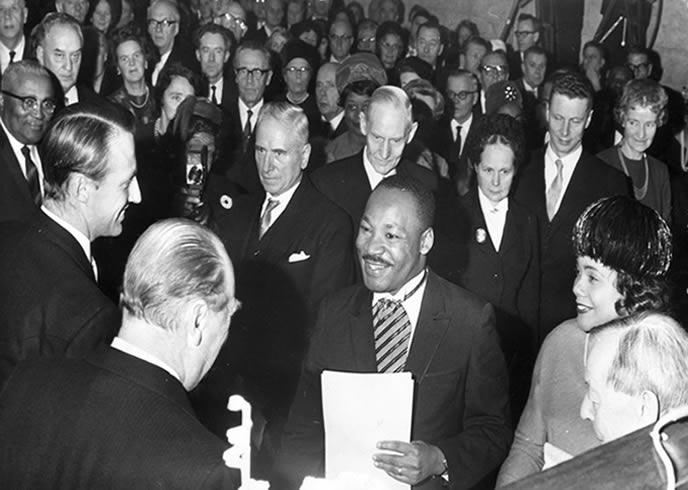
The power and effectiveness of this method of active nonviolence was so compelling that, in 1964, Martin Luther King, Jr. was awarded the Nobel Peace Prize. At his acceptance speech in Norway, King stated:

I conclude that this award is a profound recognition that nonviolence is the answer to the crucial political and moral questions of our time: the need for man to overcome oppression and violence without resorting to violence and oppression. 

Civilization and violence are antithetical concepts. Negroes of the United States, following the people of India, have demonstrated that nonviolence is not sterile passivity, but a powerful moral force which makes for social transformation. If this is to be achieved, man must evolve for all human conflict a method which rejects revenge, aggression, and retaliation. The foundation of such a method is love. [A Call to Conscience, 106]


Friday, July 10, 2020

What is Spirituality? Part IX: Hospitality


The final movement of the spiritual life is to focus on the Hearts of Others, as we move from hostility to hospitality. Now this is not inviting someone over for tea and cookies, although it may include that. It is the movement from the Latin hostis which means “enemy, stranger, foreigner,” to the Latin hostes which means being a “host” who welcomes the other as a “guest.”

We are living in a time of great confusion, anger, fear, misunderstanding, defensiveness and hurt feelings. We live in a time where nearly everyone seems to have an opinion and a need to express it. So much of our conversation, however, is talking past each other. As such, there seems to be no lack of hostility that continues to grow as we each feel misunderstood and unheard.

And so how do we turn that hostility into hospitality? If Nouwen is correct, it is through trying to suspend our own needs and convictions long enough to really listen to the other, not in order to convince them of the truth of what we believe, but so that we can come to a deeper understanding and appreciation of what the other person believes and needs.

For example, can we come to a deeper understanding of the fear of parents right now, whether it be the fear of sending their children to school in the midst of this pandemic, or the fear of parents of children of color who realize daily that they cannot protect their children from violence, including death.

James Baldwin and Ta-Nehisi Coates 
The late Toni Morrison said Ta-Nehisi Coates was the intellectual who for her filled the void left after James Baldwin died, and she describes his Between the World and Me as "visceral, eloquent, and beautifully redemptive. And its examination of the hazards and hopes of black male life is as profound as it is revelatory. This is required reading."


Ta-Nehisi Coates’s powerful book is a letter to his son:

Now at night, I held you and a great fear, wide as all our American generations, took me. . . . . Black people love their children with a kind of obsession. You are all we have, and you come to us as endangered. [We are] a people who control nothing, who can protect nothing, who are made to fear not just the criminals among them but the police who lord over them. . . . It was only after you that I understood this love, that I understood the grip of my mother’s hand. She knew that the galaxy itself could kill me, that all of me could be shattered and all of her legacy spilled upon the curb like bum wine. [82-83]

The first step in learning how to really listen to each other is to create a “safe space.”

Hospitality, therefore, means primarily the creation of a free space where the stranger can enter and become a friend instead of an enemy. Hospitality is not to change people, but to offer them space where change can take place. 

It is not a method of making our God and our way into the criteria of happiness, but the opening of an opportunity to others to find their God and their way. [Nouwen, Reaching Out, 51]

We may find this kind of hospitality difficult to offer, because we are so used to our relationships being transactional: that is, each party is in it for themselves and there is the assumption that if I give you something, you will give me something in return. 

We cannot change other people by our convictions, stories, advice and proposals, but we can offer a space where people are encouraged to disarm themselves, to lay aside their occupations and preoccupations and to listen with attention and care to the voices speaking in their own center. [54]

And so, a first step is to be able to empty ourselves so that we can be a good host. Nouwen continues:

Someone who is filled with ideas, concepts, opinions and convictions cannot be a good host. There is no inner space to listen, no openness to discover the gift of the other. Poverty of mind as a spiritual attitude is a growing willingness to recognize the incomprehensibility of the mystery of life. Poverty of mind demands the continuing refusal to identify God with any concept, theory, document or event.

A good host not only has to be poor in mind but also poor in heart. When our heart is filled with prejudices, worries, jealousies, there is little room for a stranger. In a fearful environment it is not easy to keep our hearts open to the wide range of human experiences. Real hospitality, however, is not exclusive but inclusive, and creates space for a large variety of human experiences. [74, 75]

In countless ways and places around our nation we have the opportunity to really listen to what people of color are trying to tell us about the pain and suffering they have been enduring for over 400 years. Is it possible that we might have some unique opportunities right now to really connect at a deep level?  Can we use this time to try to understand more deeply that there is experience and history beyond what we have each experienced, but which, if we are willing to listen, can teach us about the other and help us work together to transform the world into a place of greater equality, justice, peace and hope?

In these days when we may not be able to sit down across the table from someone whose experiences have been different than ours, we can still open ourselves to the unique experiences of others by reading their first-hand accounts of suffering, whether that be because of racism, coronavirus, poverty, sexism, inadequate health care, poor schools, or any of the multitude of ways in which people suffer today. 

As Nouwen writes, “When we are willing to detach ourselves from making our own limited experience the criterion for our approach to others, we may be able to see that life is greater than our life, history is greater than our history, experience greater than our experience and God greater than our God." [76]

Recent March in Selma, Alabama
We can then merge our own history and experience into the history and experience of others, and finally experience true community and solidarity. Such solidarity and deeper appreciation and understanding is what can transform the problems and challenges of our world, and at the same time fill our own lives with deeper meaning and purpose.

Saturday, June 13, 2020

What Blacks Have Been Teaching Me about Prejudice and Racism for 55 Years


Growing up, I developed prejudiced attitudes and racist ideas without myself or my family or my community really being aware of it. You would think that would be hard to do in a little, rural town of 700 in the middle of North Dakota, where the winds blow strong and the snow gets deep.

I don't think this was intentional, at least not consciously. In fact, my dad was a high school history teacher, and I would love to know how he would see the issues of today, but he died in 1965. However, as children, much of our learning about sensitive issues, like sex and race and religion, is picked up by a kind of unspoken osmosis.

First it was the Indians, as we called them. They lived on a reservation 26 miles away. I played basketball on the reservation in grade school, and noticed the unbelievable poverty. Somehow, I picked up the idea that the poverty was because Indians drink a lot and are very lazy. I already knew they were violent, because I had seen John Wayne fight them off so white folks could tame the wilderness of the west, and make something of it.

Then there were the Catholics. They might have been Christian (I wasn’t sure) but they didn’t get to confess their sins to Jesus, like we Lutherans did. They had to go to a priest and spill their mistakes to him, whereas we could keep our sins to ourselves, tell Jesus, and hope our parents didn’t find out. They also thought Mary was God. Could you believe that?

There weren’t any blacks in our town, and hardly any in the whole state. They had been slaves once, which was not a good thing, but things were all better now because we northerners had saved them in what they called the Civil War. And, if they were still treated badly in the South, they could always move to the North where we would surely welcome them.


When we traveled east toward Grand Forks and Fargo, where they raised a lot of sugar beets, I saw Mexicans bending over hoeing the fields. It looked like hard work to me, but they were glad to do it because we treated them much better than where they came from. But they better not try to stay once the farmwork was over.

Now, it is tempting to think these are the impressions of a small child that will be shed as we grow older. But are they? And to what extent?

I’m not sure when my thinking began to change, but I can point to some of the main factors. After Dad died, I--who was not known as much of a reader (I just wanted to play sports) --started going to the school library in search of some kind of meaning for my universe that had now fallen apart. In the year after Dad died, I read 47 books not required for school. These included To Kill a Mockingbird, Freedom Summer, and Black Like Me. This was the first time I encountered prejudice and a lack of civil rights, but these books were set in the South, and in no way did I see myself in the stories.

Then, through Luther League, our church’s youth organization, I got to go to some conventions where there was a focus on civil rights, especially after 1968--the year I graduated from high school--which was the year of the assassination of Martin Luther King, Jr., which led to months of protests and riots.

As soon as I hit college, I talked my way into an upper level religion course titled  “Seminar on Race Relations,” in which we read James Baldwin’s Go Tell It on the Mountain, Ralph Ellison’s Invisible Man, Martin Luther King, Jr.’s Stride toward Freedom, Claude Brown’s Manchild in the Promised Land, and Charles Silberman’s Crisis in Black and White. And everything began to change.

I began seminary on the south side of Chicago, in what we used to call the “inner city.” It was almost all black, and the poverty was rampant. Almost all the workers in the stores were black, and over time I got to know many of them. This was my first opportunity to actually have relationships with blacks.

While in my first call in West Fargo, N.D., the American Lutheran Church started offering a seminar on racism. There I learned distinctions among prejudiceracist and racism, that have informed me to this day. Prejudice is “a preconceived opinion that is not based on reason or actual experience.” Racist is “a strong prejudice against people of other races, believing that a particular race is superior to another.” And Racism is “prejudice combined with social and institutional power that creates a system of advantage based on skin color.”

The reason these distinctions are so important is that I have some control over whether or not I am prejudiced or racist, but I have no control over whether I am part of a system of racism. And battling each and all of these things is extremely difficult.

Ever since reading those books as a sophomore in high school I have tried to understand the ways in which I am prejudiced but, because those attitudes were formed mainly unconsciously when I was young, it is much more difficult to redeem them than one might think. In addition to those based on race, I have had to also try to overcome the prejudiced views I grew up with towards women, the mentally ill, gays and lesbians, other religions, other cultures etc. The list goes on and on, and only gets longer with time as we try to stay open to truth and sensitive towards what others are trying to teach us.


Then there still remains racism, which whites have even more trouble dealing with than prejudice. In part this is because it goes to the root ideals of our culture, that we are “individuals” who are to “make it on our own” by “pulling ourselves up by our bootstraps.” It is very difficult for us whites to acknowledge that our society is set up to give us certain advantages that others don’t have. 

I went to another anti-racism workshop 15 years ago in Milwaukee. Our group was very mixed racially, and through a number of exercises and discussions, we became quite close to each other. Towards the end of the workshop we were all taken outside, and asked to stand side by side in a line on a large field, holding hands. It felt so good. 

And then the leader began to ask us a series of questions: If you were raised in a family with 2 parents, take a step forward. If you grew up with lots of books in your home, take a step forward. If you were ever hungry with no food to eat, take a step backwards. If the police have ever stopped you or someone in your family because of your race, take 2 steps backward. If you needed to go to the doctor, but your family had no insurance or enough money, take 2 steps backwards. If your parents were home to help you with your homework, take 2 steps forward. If you have ever had a slur spoken to you because of your race, take a step backwards. If you have ever gone in a store and a clerk followed you wherever you went, take a step backwards. If your family had enough money for you to go to college, take 2 steps forward. 


This exercise was extremely emotional. I began it holding the hand of a black man I had really gotten to like. We tried to hold hands as long as we could, but eventually we had to let go as I moved forward. When the exercise ended, we were asked to look around at the field. People were scattered throughout, but almost everyone in the front was white, and almost everyone way in the back was a person of color. All we could do was stand there silently, and weep.


Many people believe we could be at a watershed moment in the life of our nation. But that will only be if we each have the courage to look at our prejudices and the structure of racism that undergirds our nation. Right now, I am reading Tears We Cannot Stop: A Sermon to White America, by Baptist pastor Michael Eric Dyson, which takes us deep into the experience of being black in America today, and White Fragility: Why It’s So Hard for White People to Talk about Racism, by Robin Diangelo.

Both will knock you to your knees. But that is the only way we have a chance to rise up. “Jesus answered them, ‘Very truly, I tell you, unless a grain of wheat falls into the earth and dies, it remains just a single grain; but if it dies, it bears much fruit.’” [John 12:24]