Saturday, November 11, 2023

How My Theology Has Changed, Thank God: 


Part IV: The Theology of Hope


As I left Concordia College for Chicago, people would ask me “Are you sure you want to go to seminary? Are you sure you want to be a pastor?”, and I would simply say. “I don’t know. But I am going to find out, one way or another!”


I graduated from Concordia, a few days later I married Pauline Peterson in her hometown of Bismarck, and off we headed to Mt. Cross Lutheran Bible Camp, near Santa Cruz, California, where I would serve as Program Director for the summer. It felt good to be in the Bible camping community again, which was the first of several “pushes” toward my confirming a life in the church, studying theology and learning how to incorporate the insights of faith into the life of the world.


At seminary you don’t get to gently stick your toe into the water. It is a baptism of total immersion. You take courses in Old Testament, New Testament, Church History, Practical Theology (preaching, teaching, pastoral care, etc.), and, my favorite, Systematic Theology, where you work on “constructing” your own spiritual and theological view of God and the world.


This may surprise you, but going to a seminary in the ELCA is not an indoctrination into what you are supposed to believe and do. It is rather a place to search, ask questions, study what the great theologians and biblical scholars of all ages have thought and written and then enter into intense discussions with your teachers and fellow students. 


As I took Old Testament courses, I soon learned that most of my teachers believed what I had sensed, that Christianity is not a repudiation of Judaism, but a fulfillment of it, bringing Gentiles (non-Jews) into the covenant that God had established with Abraham and Sarah, Moses and Jeremiah. The simplistic view that the Old Testament is all law, with grace arriving only in the New Testament, is inaccurate. The First (Old) Testament is filled with grace, love, forgiveness, compassion and the presence of God. 


In my New Testament courses, I finally was able to get beyond an almost singular focus on the “Christ of Faith” that is inherent is the Cosmic Theology of sin and redemption I referred to earlier, and I was able to begin to study the teachings and deeds of the “Jesus of history.” 


However, what really set a theological fire under me was, under the tutelage of Dr. Carl Braaten, diving into the study of the history of theology in the church, up to the present moment. And that present moment contained a new theology that would radically transform my view of God, church and world: Jurgen Moltmann’s Theology of Hope, published in 1964. This is no whimsical “power of positive thinking.” Rather, this theology begins with the suffering, pain and injustice of the present world and looks not to the past, but to a new future of healing and deep hope based on God’s vision for the world. As I put it in my recent book:


While much theology tries to “repristinate” the past and return to a Garden-of-Eden paradise, the Theology of Hope looks not to the past, but to the future to find meaning, direction and, yes, hope and inspiration. God continues to come to us from the future, giving us new visions and revelations of what can be. God’s Kingdom is already present among us through the coming of Jesus, the Christ, but its fulfillment remains in the future. Thus, when someone states, “but it has always been that way,” the Theology of Hope responds, “But it doesn’t have to always be that way.” God is at work relentlessly to show us new ways to approach the struggles of the world. Our task, then, is to remain open to revelation. [Freed to Love and Live Again, 57]
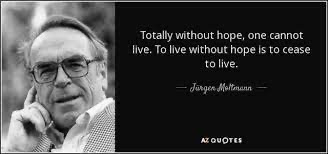


Moltmann came to this theological understanding through painful experience. He was raised in a non-religious family, studying the classics of literature and science. As a young man he was drafted into the German army during World War II, eventually was captured by the British and then spent three years in a prisoner-of-war camp. Not only did he carry with him the horrors of the war he had already experienced, but in the prison camp he was shown pictures of “the concentration and extermination camps at Belsen and Auschwitz. The initial disbelief among the German soldiers soon gave way to a grave realization that they had indirectly participated in these horrors. As Moltmann recounts in his book The Source of Life, “The depression over the wartime destruction and a captivity without any apparent end was exacerbated by a feeling of profound shame at having to share in this disgrace.” [Douglas Koskela, “Remembering the Future,” Response, Seattle Pacific University, Fall, 2008]


His way out of his despair and hopelessness began when a chaplain gave him a copy of the Bible. He was confused by much of what he read but was very moved by the Psalms of lament and the Passion of Jesus. Referring to the gospel of Mark, Moltmann writes: “When I came to Jesus’ dying cry, I knew: ‘There is your divine brother and redeemer, who understands you in your god-forsakenness.’” He continues, “The experiences of the life of a prisoner have left a lasting mark on me: the suffering and the hope which reinforce each other. When one grasps the courage of hope, the chains begin to hurt, but the pain is better than the resignation in which everything is a matter of indifference.” [Moltmann, How I Have Changed, 13]


When Moltmann was finally released from prison, his next task was to find a church and theological movement to join. He wanted no part in the many churches who had capitulated to, and thereby supported, the Nazi movement. Although he was impressed by those who had signed the Barmen Theological Declaration which declared a clear “no” to Hitler, and the “Christ alone” theology of Karl Barth that tries to separate faith from politics, he joined those who “wanted to give positive answers to the political possibilities and cultural challenges of the post-war period.” [Have Changed, 14]


As Moltmann begins to construct his theology, he works from both the suffering and hope he had experienced in captivity, beginning with the experience of hopelessness:


Totally without hope one cannot live. To live without hope is to cease to live. Hell is hopelessness. It is no accident that above the entrance to Dante's hell is the inscription: "Leave behind all hope, you who enter here." That is why faith, wherever it develops into hope, causes not rest but unrest, not patience but impatience. [Theology of Hope, 32]


What is the anecdote to the despair and hopelessness we all feel at times? For Moltmann, it is the resurrection of Jesus Christ, but understood in a new light, not leading to passivity, but to love, compassion and action, including political action.


Believing in the resurrection does not just mean assenting to a dogma and noting an historical fact. It means participating in this creative act of God’s … Resurrection is not a consoling opium, soothing us with the promise of a better world in the hereafter. It is the energy for a rebirth of this life. This hope doesn’t point to another world. It is focused on the redemption of this one.


Faith sees in the resurrection of Christ not the eternity of heaven, but the future of the very earth on which his cross stands. It sees in him the future of the very humanity for which he died. That is why it finds in the cross the hope of the earth. [Hope]


Koskela explains the understanding of resurrection that undergirds Moltmann’s theology:


The resurrection is a powerful word of promise that stands in contradiction to our present experience of suffering and death. Yet this is not a promise that we await passively. On the contrary, we move forward in the light of hope toward the transformation of the world that God will bring. “To believe,” Moltmann writes, “means to cross in hope and anticipation the bounds that have been penetrated by the raising of the crucified.” [Ibid.]


With this understanding in mind, one enters loving action:


That is why faith, wherever it develops into hope, causes not rest but unrest, not patience but impatience. It does not calm the unquiet heart but is itself this unquiet heart in man. Those who hope in Christ can no longer put up with reality as it is, but begin to suffer under it, to contradict it. Peace with God means conflict with the world, for the goad of the promised future stabs inexorably into the flesh of every unfulfilled present. . . Hope is lived when it comes alive, when we go outside of ourselves and, in joy and pain, take part in the lives of others. [Hope]


It would be difficult to exaggerate what a profound effect the Theology of Hope had on my life and vocation. Here was an understanding of God not as a passive judge distant from our suffering, but as one who enters our suffering with us, being present with us in that suffering, crying with us in it. This description of God began to make it possible for me to feel close to God again, as I had in my youth. 


Secondly, here was an understanding of redemption--not as escape from this world with a focus on life after death--but as a deep and powerful engagement with the pain of this life. This theology takes seriously the life and mission of the historical Jesus of Nazareth, who lived a life and founded a movement that welcomed all, based on inclusivity, forgiveness, love, acceptance, solidarity and compassion.


Year later, when I would study the Theology of Liberation, one of its proponents, Rubem Alves, wrote these words about the suffering and hope upon which Moltmann built his theology:


The two, suffering and hope, live from each other.

Suffering without hope produces resentment and despair,

hope without suffering creates illusions, naiveté, and drunkenness . . .

Let us plant dates,

even though those who plant them will never eat them.

We must live by the love of what we will never see.

This is the secret discipline.

It is a refusal to let the creative act be dissolved

in immediate sense experience

and a stubborn commitment to the future of our grandchildren.

Such disciplined love is what has given

prophets, revolutionaries and saints

the courage to die for the future they envisaged.

They make their own bodies the seed of their highest hope.

-- Rubem Alves
 

As I sit at my desk in my early 70’s, the same theology that gave me “hope” in my early 20’s continues to call me into active love today. As Moltmann put it so well:


As time goes on, we become old, the future contracts, the past expands. . . But by future we don't just mean the years ahead; we always mean as well the plenitude of possibilities which challenge our creativity. . . In confrontation with the future, we can become young if we accept the future's challenges. [Hope]


Friday, November 3, 2023

How My Theology Has Changed, Thank God


Part III: The Journey into Exile


Concordia College, Moorhead, Minnesota

When I left home for Concordia College, in Moorhead, Minnesota--an ELCA Lutheran school--two things happened almost immediately. I was no longer held close and safe in the bosom of my home congregation nor the Bible camping community. Secondly, the world was now wide open for whatever I wanted to study, and I felt the freedom to bring forth fully the struggles I was having with the belief structure in which I had been raised. One of the first issues I took on was the relationship of God to the suffering and grief I had experienced. 


If, indeed, God was all-powerful and all-knowing, then God surely had the ability to keep my parents from dying. I had prayed fervently for them to be healed, but it didn’t happen. Maybe I didn’t pray in the right way. Maybe my faith wasn’t strong enough. Maybe God was judging me for this, and that’s why my prayers were not answered the way I wanted them to be. 


I began to drift away from God. Either I wasn’t a good enough Christian, or God didn’t care enough about me to save my parents from death. Either way, I no longer felt close to God. I didn’t feel I could count on God. I entered college thinking I wanted to be a pastor, but that no longer felt like a path I wanted to pursue. 


I was like the Biblical person, Job. He had been a faithful follower of God, but God had turned on him (or so he thought), taking from him everyone and everything he loved, leaving him in pain and suffering. Like Job, I began to question whether God really was a God of love, a God who would be there for me no matter what happened in my life.  Like Job, I was ready to throw out God rather than throw out my theology. Like Job, the only way I could feel close to God was to begin to question my theology and my assumptions about who God was and how God was related to me and the world. Job does this by challenging God to explain who God really is, and, when God speaks to him out of a whirlwind, Job realizes his theology had it wrong. He had assumed that if he was a faithful follower of God he would not suffer. Now he begins to understand that suffering is a part of life for all of us and God doesn’t guarantee that we will not suffer, but God does promise to be with us in the suffering. 


Well, I hadn’t studied the book of Job when I entered college, and I decided to take another track. I would major in Philosophy to try to understand how the great thinkers of the ages understood God, and I also majored in World Religions, focusing on how the other great religions of the world understood God. Both approaches were extremely helpful, but they also led me to begin to see the relativity of some of my Christian understandings. Of course, to a pious Christian this might seem heretical, but it gave me the courage to begin to question my childhood theology, and whether it was the best way to conceive of God and the world.


Dr. Paul Sponheim

Marcus Borg did the same kind of questioning at Concordia. And he and I were, in part, both saved by the same man, Dr. Paul Sponheim: Marcus as a student at Concordia, and me later when Dr. Sponheim began to teach at Luther Seminary in St. Paul. Marcus writes about his first course from Dr. Sponheim:


The course covered all the big questions: God, the nature of reality, human nature, evil, atonement, ethics, the relationship between Christianity and other religions. It exposed me to the diversity of answers provided by the intellectual giants of the tradition, ancient and modern. . . The experience was fascinating and liberating. Its effect on me was that the sacred cows of inherited religious belief began to fall in a way that legitimated their demise. But it didn’t help me to believe. Rather, it provided a framework within which I could take my perplexity seriously.


As college ended, the images of Christianity and of Jesus that I had received as a child were no longer persuasive or compelling. My childhood understanding of Christianity had collapsed, but nothing had replaced it.  [Again, 8]


My own experience was similar. While the issue that consumed me most was the relationship of God to human suffering, there were other issues as well: the literal interpretation of scripture (regardless of the genre of the writing); the presenting of the faith as primarily a cosmic drama focused on the  issue of human sin, with the primary purpose of Jesus being to die to forgive that sin, thereby neglecting the historical Jesus' teachings about "the way" to be God's faithful people in the world;  emphasizing the afterlife at the expense of this life; the participation of the Christian church--supported by what I saw as “bad theology"--in so much violence both throughout the centuries and in the present world; the racism and sexism present in the theology of the church as well as in the practice of the Christian community. Related to this was the exclusivity and judgmentalism I detected in so many places as compared to the amazing welcome, compassion and inclusion I observed in the life of the historical Jesus. [See Convictions, 9-12]


The two people who shepherded me as I reflected on my faith at Concordia were the two men who guided me in what would become my two majors, Philosophy, with Dr. Tom Christiansen, and World Religions, with Dr. Larry Alderink. Philosophy gave me the tools to think critically and logically about what I did and did not believe, and World Religions not only furnished me with unique and new religious insights but also a basis of comparison as I began to think more critically about what I believed as a Christian.


I will discuss these insights in later posts, but for now I want to turn to the key theological issue that confronted me at that time: the relationship of God to human suffering.


When my parents died, I accepted as truth what I had been taught: that God controls everything that happens in life, and therefore, as painful as it might be, my parents’ deaths were “God’s Will.” This seemed to work for a while, but, as I began in college to look at other ways of seeing God’s relationship to the world, I found myself feeling less and less close to God. I quit going to worship, I seldom prayed, and, although I resisted admitting this at first, I began to feel angry at God. 


This became one of the most difficult and painful times in my spiritual journey. I had loved God so much, and felt so loved by God, but now that began to change. It was clear I could not feel close to the God of supernatural theism (defined at the end of the last post). Does that mean I reject God entirely, or do I search for another understanding of God?


The spiritual journey, with all its twists and turns, does not result--as we say in financial analysis--in a V-shaped recovery, where you head steeply down and then immediately begin an upward ascent. No, first there is the “valley of the shadow of death,” the “forty days and nights in the wilderness,” or, perhaps, most profoundly, a period of Exile, as when the ancient Babylonians conquered Israel and sent her people far away from home to the land of Babylon, where they were separated from all that they loved and held dear. In the words of Borg, 


As a life of being separated from that to which one belongs, exile is often marked by grief, as in one of the psalms of exile: “By the rivers of Babylon, there we sat down and wept when we remembered Zion.”


In our own lives, the experience of exile or estrangement or alienation can be felt as a flatness, a loss of connection with a center of vitality and meaning, when one day becomes very much like another and nothing has much zest. We yearn for something that we perhaps only vaguely remember. Life in exile thus has a profound existential meaning. It is a living away from Zion, the place where God is present. [Again, 126]


Of course, what one longs for in Exile is a Return, a return home. That seldom happens overnight. As I wrote in the first post of this blog series, the spiritual journey is a long and, at times, dangerous quest. Borg states clearly the task that lay before me:


The task of theology is not primarily to construct an intellectually satisfying set of correct beliefs. Its task is more modest. Part of its purpose is negative: to undermine beliefs that get in the way of taking Christianity seriously. Part of its purpose is positive: to construct a persuasive and compelling vision of the Christian life. But being Christian isn’t primarily about having a correct theology by getting our beliefs right. It is about a deepening relationship with God as known especially in Jesus. [Convictions, 50]


In exile I longed for that relationship. I wanted to return. But return to what and to whom? It was time to throw out some of the theology of my upbringing and begin the task of building a new understanding of God and a new vision for myself and the world. 


In my final year of college, with my Philosophy and World Religion courses behind me, I again took a couple of courses in Christian theology. That was the beginning of my return from exile, and while I still felt far from home in many ways, I made the decision to pursue these studies further, and I headed off to seminary at the Lutheran School of Theology in Chicago to do just that.


Saturday, October 21, 2023

How My Theology Has Changed, Thank God


Part II:  Lutheran Prairie Pietism: The Positive


Like all theologies, there are aspects that can be very helpful, and other aspects that can be negative and detrimental to one’s spiritual journey. In this post I will reflect on the positive of what I have labeled as my childhood faith: Lutheran Prairie Pietism.  First, let’s unpack what I mean by these three terms. And, since as a child I was in the state of what we have called precritical naivete (see last post), I write from the perspective of a child (with an adult voice now), learning and absorbing what they observe as they look up at the adults around them. 


We were definitely Lutheran, and proud of it. There might be equals, but no one understood God’s Grace better than we. Of course, as a child I had no idea what this meant, but as I progressed through grade school into junior high--when confirmation classes began—I came to understand that God is indeed a God of love. And that love is “unconditional,” based solely on God’s desire and choice to love and accept us “just as we are,” without any need for us to be good or sinless. While we did not dwell on sin and our unworthiness like many more fundamentalist denominations do, we still knew that we were all “sinful in thought, word and deed,” as our liturgy put it. I still remember Dad coming home from a day at his furniture store, aghast that a farmer who came to town stated to Dad that he had never sinned. Dad, good Lutheran that he was, was just plain astounded that anyone could believe that.


By prairie, I mean that we were rural folk. It didn’t matter whether you lived on a farm or in a small “farming community” of some 700 saints, as I did: everyone knew quite a bit about farming, and even we city folk helped with the harvest, such as hauling grain to the local elevator. When the Bible talks about sheep and goats, or wheat and barley, or weeds in the crops, or the need for rainfall, or the wolf who comes to devour, we were right at home. In a sense, you might also label us as populist, in that we saw ourselves as ordinary people who were often misunderstood by more affluent, “large-city folk.” We just kind of sensed that we were more at home in the Bible than those folks, and that made us feel pretty good about ourselves, even though, believe me, a good Norwegian Lutheran was supposed to think and act anything but proud. A little self-confidence was okay, but don’t let it get out of hand. I played tight end in football, and when you caught a touchdown pass, you slowly walked over to the ref and handed him the ball, making sure you did not make eye contact.  


Finally, we were pietists, which Merriam-Webster defines as “a 17th century religious movement originating in Germany in reaction to formalism and intellectualism and stressing Bible study and personal religious experience.” That movement eventually made it to Scandinavia and came with the Norwegian and German immigrants who made up the bulk of those who settled in North Dakota. Bible study was important at every stage of life, from Sunday School through Confirmation through Adult Education.  As prairie populists, we were very “low-church,” not getting caught up in fancy liturgical garb, like chasubles, or in many traditional liturgical rituals, like being anointed with ashes in the form of a cross on the forehead on Ash Wednesday, or elaborate chanting during the Holy Communion. We wanted everything simple, with the focus on having a personal relationship with God and Jesus. Not that we were into Billy Graham style “decision” theology or altar calls, but we were encouraged to develop a strong devotional and prayer life as we turned ourselves over in trust to our loving God. I saw Mom do this every morning, as she began her day with her Bible and the Christ in Our Home devotional booklet handed out free in church at the beginning of each month. 


In fact, this relational, pietistic perspective eventually evolved into the most important and positive aspect of the form of Christianity in which I was raised. Up until Confirmation, my church life was about worship and learning the stories of the Bible. That continued in Confirmation, but what really strengthened  my faith was when our new pastor, Elmo Anderson, took us confirmation students to Red Willow Bible Camp for a weekend retreat. Singing around a campfire and hearing older folks give a more personal description of God’s love in their lives--as compared to normal Sunday-morning worship--really inspired and excited me. 


This got a further boost when, in the summers after 7th and 8th grade, I spent three weeks at the same camp. Now it was college students sharing their faith journeys and leading the Bible studies. This continued as I worked as a counselor at Red Willow and other camps during my high school summers. I felt such a deep sense of community, bound together by love in the Bible camp community, and my own personal feelings of closeness to God and Jesus continued to grow. I didn’t have a need to question the elements of the faith I was being taught, and now experiencing, because life was good, and everything just seemed to fit together in a positive way.


That began to change in the summer of 1965, my first year as a counselor, when my dad died of cancer. It changed further less than two years later, when my mother also died of cancer. [See Chapters 1 and 2 of my book, When the Northern Lights Went Dark, Amazon].


At first my childhood faith bolstered me. Almost all of the other counselors at camp came to the funerals of my parents, and my home church of North Viking Lutheran surrounded me with love and care. I was encouraged to accept the deaths of my parents as just part of God’s Will, even though I, of course, couldn’t understand why God would want to do this to me. In fact, as I describe in chapters 3 and 4 of the book above, I entered a time of deep prayer and piety as I stayed extremely active in the church, which now included leadership in Luther League, the youth program of our church, at the local, synod land national levels. 


This kept me going for a while, but, by the time I entered college, cracks had begun to form in my view of the Lutheran Prairie Pietism in which I had been raised. Borg also describes how this began to happen in his life. If God really was “up there” in “heaven,” Borg writes, “I had taken the first step in removing God from the world. The solution I arrived at indicated that I had come to think of God as a supernatural being ‘out there.’ God became distant and remote, far away and removed from the world, except for special interventions.” [Borg, Meeting Jesus Again, 6] Borg terms this "supernatural theism" [The God We Never Knew, 11]


As I left home to begin college, I found myself in a spiritual quandary. Emotionally, my pietistic attempts to stay close to God were no longer working. It was difficult to feel close to the One who's Will was apparently that my parents should die.  Intellectually, like Borg, I increasingly saw God as detached and distant from the world, and thereby unavailable to me in my pain. Worse yet, I wondered if God was perhaps punishing me, although I could not figure out why. Was I missing something? Or was God not who I thought God was?


Friday, October 13, 2023

How My Theology Has Changed, Thank God


 Part I:  Don’t Throw God Out with the Bath Water


One of the strange things about humans is that we get so attached to our beliefs and theology (how we understand God and the world) that we often throw out God before we throw out, or revise, our theology. This is what I tried to do in my college years, but, thank God, rather than throwing out God I continued the intellectual and emotional struggle to deepen and enlarge my theology to better reflect the way the world is and what I actually do believe, rather than what I felt like I was “supposed” to believe.


The spiritual journey is a dangerous quest. It is a quest, which the dictionary defines as “a long or arduous search for something,” [Oxford] and the holy grail is always truth: truth about the world, about me, about God, about how God wants us to relate to one another and all creatures, big and small.


It is dangerous because to be true to this quest, we will have to be honest about and with ourselves. We begin the quest with all kinds of baggage, and some of it will need to be cast off and replaced, hopefully with something better and “more authentic, more true.” I know my theology, which has evolved through so many iterations already, will no doubt need to continue to evolve, which again, according to the dictionary, means “the gradual development of something, especially from a simple to a more complex form.” [Oxford]


As I describe the evolution of my spiritual journey, my traveling partner will be the late Dr. Marcus Borg (1942-2015). I choose him because, not only is he one of the most profound New Testament biblical scholars and theologians of the past half century, but because his Lutheran upbringing was so similar to mine, and his writings have helped me understand how I was raised and what I was taught--from the very beginning--to believe about God and the world.


Marcus grew up in rural North Dakota, just as I did, eight years before me. He attended Concordia College in Moorhead, Minnesota, just as I did, and he returned there, with his doctorate, to teach right before I arrived, and right after I left. (I assume this was a coincidence.) 


I first encountered his work thirty years ago when I was a pastor in Fargo, ND, and I read (and then taught in the congregation) his 1994 book, Meeting Jesus Again for the First Time, in which he describes the elements of the Christian theology in which he was raised, essentially the same theology in which I was raised 100 miles to the west of him.


My Home Church, North Viking Lutheran, Maddock, ND

I will describe that theology, which I label Lutheran Prairie Pietism--with its pros and cons--in the next two blog posts. But, before getting to that, it is helpful to consider Borg’s description of the three-step theological process that informed his own life. This is the move from precritical naivete  through critical thinking toward postcritical affirmation or conviction. (This sequence was first developed by French philosopher, Paul Ricoeur)


In the first stage of precritical naivete, we take it for granted that whatever significant authority figures tell us is true is indeed true. And we have no reason to think otherwise (Borg, Convictions, 53-54). Along with the cultural beliefs that a tooth fairy puts money under our pillow and Santa Claus brings gifts through a chimney, we were told the world was created in six days, a special star led the Wise Men from the East to Jesus, God is all-powerful and controls all that happens, sitting on a throne watching everything we do and think, and men are more important in church and society than women. 


The critical thinking stage begins when you start to develop a “suspicion” (this term is from Liberation Theology, which we will discuss later) that something you have been taught may not be “actually” true. A common example of this is the study of science. Christians and the church struggled with Copernicus’ assertion that the earth is not “actually” the center of the universe, as the Bible implied. I can still remember learning in high school about the age of the stars and universe, and wondering how this could be when the Bible had all of creation happening in a week. The common response that for God a day is a thousand years was not particularly helpful.


However, the real challenge comes when you move from intellectual curiosity to emotional pain. Like Marcus Borg, whose father died in Borg’s early twenties, my dad died when I was 15. This was followed by my mom’s death when I was 17. For a while my Lutheran pietism kept me going. But then a crack in my faith began to form. After all, if God did indeed control everything that happened in the universe, then why would God “choose” to take both my parents from me at such an early age? I was, in fact, facing in my late teens the issue all religious humans face sooner or later: what is the relationship of God to human suffering and pain?


This was the point when I was first tempted to throw the baby (God) out with the bath water (my childhood, precritical, naïve theology). The only way I could keep from doing that was to use critical thinking to build a new theological and spiritual understanding in the journey for a postcritical, authentic, integrated theology representing my deepest-held affirmations and convictions which was, at the same time, more in harmony with what we know about the world.


In the next post we will consider, first, the strengths of Lutheran Prairie Pietism when it came to the issue of loss, grief and God’s Will, and then, in the third post, the ways in which my childhood theology no longer worked for me, and which aspects of it I had to jettison. 


Following that I will share the insights I have gleaned from so many differing people and places as I began to develop my own postcritical theology, which includes majoring in college in both Philosophy and  World Religions, and then, later, the study of the Theology of Hope, the Crucified God, Process Theology, Liberation Theology, the Historical Jesus, Eastern Mysticism,  the Beloved Community articulated by Martin Luther King, Jr., and, finally, Revolutionary Love (Valarie Kaur), which includes a commitment to and  hope for the future of those whom I love and the world of strangers out there who are a part of me I don’t yet know. (Kaur)


Friday, January 21, 2022

Active Nonviolence, Part III: It is Spiritual


It takes a very spiritual person to continue to practice active nonviolence, because such practice always leads to significant resistance, if not outright violence towards oneself. In Parts I and II of this three-part series, we looked at how active non-violence is dangerous as it works within a framework that respects and obeys the law, unless the law is believed to be unjust. Finally, active nonviolence is spiritual, which gives it its staying power, in spite of constant resistance.


On this Martin Luther King, Jr, national holiday, I watched a movie about the last two years of King’s life: King in the Wilderness. These were the most difficult years of his life as he and the Southern Christian Leadership Conference had decided to broaden their focus beyond racism to war and poverty. As King himself put in 1967--following Muhammad Ali, who the year before had refused to go to war in Vietnam--how could he speak out against the violence directed at blacks in the US and not say a word about the violence being directed at the poor, brown people of Vietnam. 


When King reluctantly became the nonviolent leader of the Montgomery Bus Boycott in 1955, he met much resistance and criticism, but by the time the Civil Rights and Voting Rights Acts were passed in 1964 and 1965--and he had received the Nobel Peace Prize in 1964--he had become a hero to many people of all races and nationalities. However, once he went north to Chicago to protest the racism and poverty inherent in northern cities, and then, in 1967, spoke out against the Vietnam War, all that changed. 


He was again vilified in newspapers across the country, and J. Edgar Hoover of the FBI--who had been wiretapping King--began closing in on him in an attempt to label him a communist. 


All of this wore heavily on King, and he became depressed and afraid, worrying that the movement he had worked tirelessly to build would be destroyed. He also had received enough death threats over the years to know his own life was at stake. 


He went through a very dark period, but then a revelation came to him: you are not truly free until you are no longer afraid of death. And now he had come full circle, realizing that the spirituality that had driven him into a life of nonviolent change would also be the spirituality that carried him through his darkest moments, including the possibility of death.


Dexter Ave. Baptist Church, Montgomery, Alabama

That spirituality was true from the beginning of ministry. In his first call, at Dexter Avenue Baptist Church in Montgomery, in a 1956 sermon he stated:  “I still believe that standing up for the truth of God is the greatest thing in the world. This is the end of life. The end of life is not to be happy. The end of life is not to achieve pleasure and avoid pain. The end of life is to do the will of God, come what may.”  


Two years later, in a sermon at Purdue University, King again described the way his spirituality directed his life and decision-making: “So I say to you, seek God and discover him and make him a power in your life. Without him all of our efforts turn to ashes and our sunrises into darkest nights. Without him, life is a meaningless drama with the decisive scenes missing. But with him we are able to rise from the fatigue of despair to the buoyancy of hope. With him we are able to rise from the midnight of desperation to the daybreak of joy. St. Augustine was right—we were made for God and we will be restless until we find rest in him.”  [“Measure of a Man”]


This spirituality would continue to guide him over the ensuing years, and it would find its deepest meaning near the end of his life when many, including some of his friends, would turn on him because they felt he had gone too far in criticizing the Vietnam War. 


Martin Luther King. Jr., Riverside Church, NYC, April 4, 1967

His primary speech against the war took place at Riverside Church in New York on April 4,1967.  Then, four months later, in the midst of his depression and despair, he speaks to his fellow civil rights leaders, stressing the importance of faith and spirituality in creating a meaningful life, calling on all of us to align ourselves with the “creative force” of God in the universe: “When our days become dreary with low-hovering clouds of despair, and when our nights become darker than a thousand midnights, let us remember that there is a creative force in this universe, working to pull down the gigantic mountains of evil, a power that is able to make a way out of no way and transform dark yesterdays into bright tomorrows. Let us realize the arc of the moral universe is long but it bends toward justice.” (Speech to SCLC, August 16, 1967.)


In the last months of King’s life, the deep struggles continued, but he stayed committed to the nonviolent struggle, even as many in the black community were chastising him, saying nothing important would change without violence. But through the darkness of conflict and criticism, King came to realize that he likely would not live a long life, and he made peace with that, finding freedom in no longer fighting the possibility of death as he focused on what he had believed in and spent his life working on. Exactly one year after his sermon at Riverside Church, on April 4, 1968, he was assassinated in Memphis. The evening before, in a speech to the Memphis sanitation workers, whose protest he had joined, he ended his reflection with these words:


Martin Luther King, Jr., Memphis, April 3, 1968

“Well, I don't know what will happen now; we've got some difficult days ahead. But it really doesn't matter with me now, because I have been to the mountaintop. And I don't mind. Like anybody, I would like to live a long life. Longevity has its place. But I'm not concerned about that now. I just want to do God's will. And He's allowed me to go up to the mountain. And I've looked over. And I've seen the Promised Land. I may not get there with you. But I want you to know tonight, that we, as a people, will get to the promised land! And so I am happy tonight; I'm not worried about anything. I'm not fearing any man. Mine eyes have seen the glory of the coming of the Lord!"


"Out of the mountain of despair a stone of hope." from "I Have a Dream." MLK Memorial Washington DC